Birthday in Honfleur

Last Friday, 18 August, was my birthday – don’t even think of asking how old. We planned a trip to Honfleur. This was a dual-purposed journey – celebrate another trip around the sun and a dentist appointment in neighboring La Havre. Before you send sympathy comments regarding a dentist visit and joyeux anniversaire, remember that we are foodies and teeth are tools of the trade, so it was all good.

The dentist was on Monday, just before we drove home. Our dentist spoke some English, and we some French, so it went quite well. We both really like her. The dental office and procedure was similar, yet different, than in the US – it seemed more casual, which I liked. She repaired a filling of mine, part of which fell out while we were in Reykjavik. No anesthetic was needed. Now to the important stuff.

Honfleur is a port town on the mouth of the Seine. The heart of the city is built around a small harbor. It is a city for food folks, especially if you like seafood as much as we do.

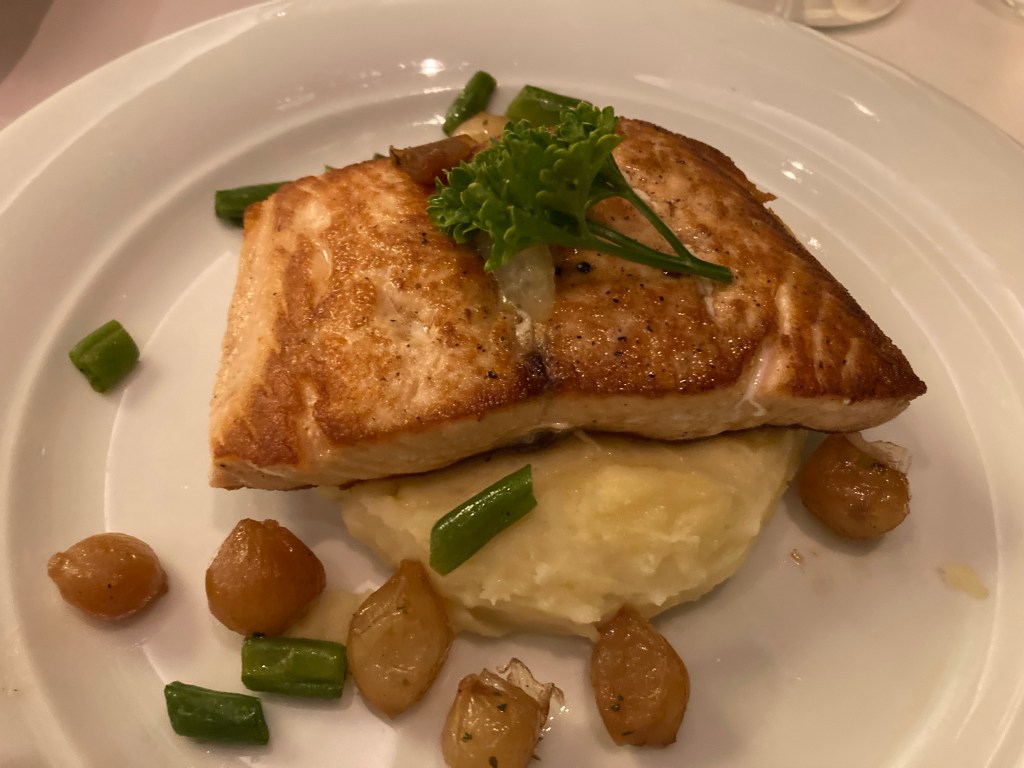
Friday we ate lunch, our main meal of the day, at Restaurant Le Sainte Catherine. Tricia, ever alert for things I like, spotted grilled sardines on the chalkboard, so the search was over. Sitting at a table next to the harbor was a bonus. Sadly, I was so in a rush to eat them I did not take a photo.

One friend already commented that sardines did not seem like a very good birthday meal. If your only exposure to this wonderful fish is the small, flat cans that you see in most grocery stores, I can understand. As an aside, seafood in those cans is quite different in Europe. There are stores that specialize in canned seafood, and it is all amazing.

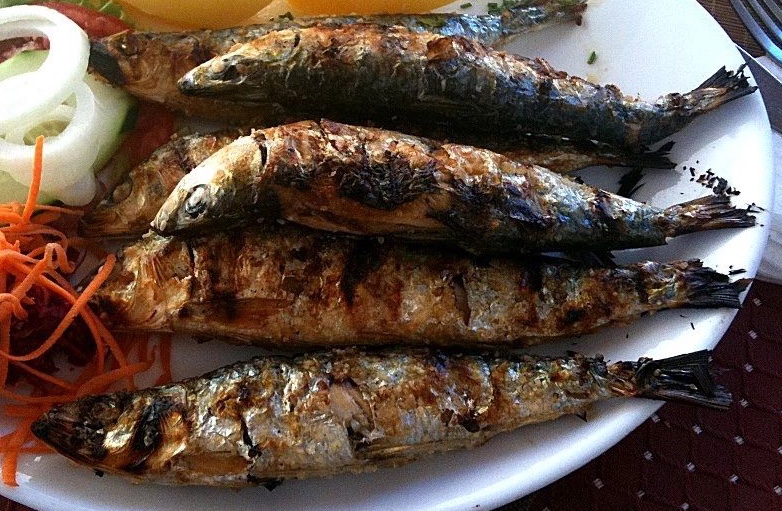
Sardines are plentiful in any poissonnerie here in France. They are between six and eight inches long, sold cleaned, with the head on. The most common preparation is grilling, until the skin is browned, and best when over charcoal. To eat you cut across at the tail, then peel the top half toward the head, leaving the bones behind. Then the bones and head are easily discarded, leaving you with a delightful fillet. Here is a stock photo from the internet of how the sardines look.
On Saturday we visited Sainte Catherine’s church, the largest wooden church in Europe, and composer Erik Satie’s museum. Watch Tricia’s blogs for a post in the near future about this eccentric fellow.

Churches and museums work up quite an appetite, so it was time for lunch. We found a table right on a pedestrian street at Homme De Bois. We shared raw oysters for an entree. Langoustines, along with lobster, are never high on my list, but I decided to give the langoustines a go, and it was well worth it.

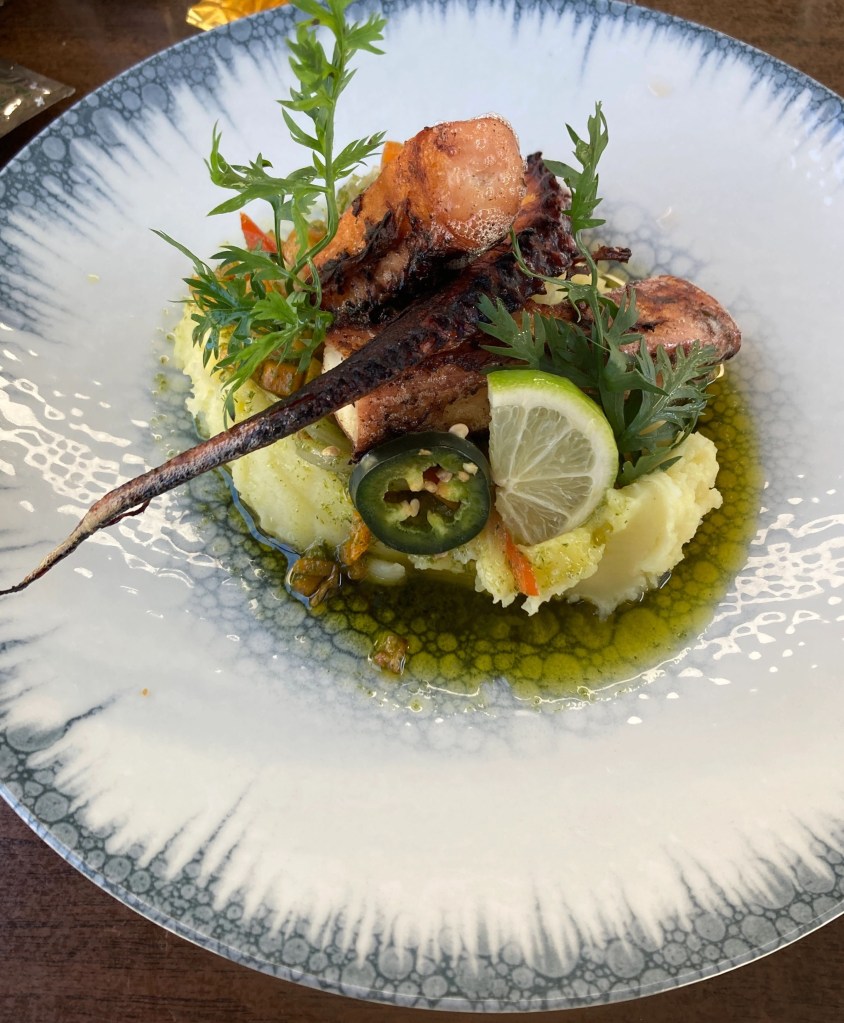
Sunday we wandered through a couple of parks, then headed for lunch back near the water – Cote Resto. After another plate of oysters, I had grilled octopus. Octopus is a delicate thing to cook just right, you want it charred, but if it is cooked too long it gets rubbery. This one was perfect.
Yesterday we drove home, about a two-hour drive. For lunch, we stopped at one of our favorite French amenities, the aire de repos. These wayside stops are placed every 20-40 kilometers on the Autoroutes, so you do not have to leave the toll road for gas, food, or a break. Since it is France, coffee is available either from machines (yes plural, lots of machines) or from a counter complete with enough baked items to make many boulangeries proud. But our choice is usually a packaged chicken salad sandwich, and if we are feeling decadent a bag of chips. It is a simple fare, but quite enjoyable as we head out down the 130k/hour Autoroute for home.

It was a memorable weekend. Fortunately the dentist found a small cavity, so we will get to go back for a day or so at the end of October. Oh darn.

La Baguette and Family Secrets

We have been hiding a family secret since July of 2007 – 16 years. Now, living in France, it is time to come clean. We – Alexis, Tricia, et moi – visited Paris, along with my dad and stepmother in 2007. Tricia had a great idea for a Christmas card photo for that year.

My dad took this photo. The three of us in a perfect stereotypical French pose – baguettes and the Eiffel Tower. Note carefully the three baguettes, specifically the paper around them. Note that Alexis’s is different. (Also notice her Pichard looking red bag.)

We bought the baguettes on the way to the Tower. Like many French people would do, Alexis broke off le crouton or le quignon (depending on which part of France you are in) and began to eat. It is the first end of the baguette and considered a delicacy.

She ate the first bite, then a second, and a third, and … Well by the time we got ready for the photo-shoot she only had about six inches of the Baguette left. I understand completely, yesterday I bought a baguette, which I proceeded to eat, with Tricia’s help, until it was about half gone.

So when we finally were ready to take the photo, Alexis had to hold her mostly empty bag, with just the remaining tip protruding, not a whole baguette, as the picture portrays. So now you know the whole story.

In France there are four essentials for living: Une baguette, du vin, du fromage, et un café – bread, wine, cheese, and coffee.

In a small village like Ceaucé, our nearest village, you can always find a baguette in the early morning. If the boulangerie is closed, there will be a sign in front of the small convenience store that they have bread. Yesterday they were both closed, so the sign was in front of the charcuterie. A charcuterie is a meat and sausage market, but behind the counter was a large bundle of baguettes. They only cost 1.05€, regulated by a government that believes essentials should be protected. She handed me my baguette, which, in true French fashion, had no wrapping of any sort, just a delightfully crusty baguette. Folks in the USA would cringe, but the French think we are too fussy about such things.

Wine in France is also quite affordable, a nice Cote de Rhône will cost around 4€, it would be $15-20 in the US. I get wonderful Camembert rounds, from right here in Normandie, for 2-4€. So for under 10€ a person can eat quite well, with room left over for un café at a local café.

My friend Shirley, will most likely tell me I left out croissants, but for the French, croissants are more of treat than an essential, but like Shirley I could easily add them to the list. And the French do adore their croissants.

One of the concepts that I like about France is that the essentials for quality of life are quite simple. That is a lesson I hope to keep from our time here in France. Tricia likes the statement La vie est belle, and I think the simpler you make it the better it is, thank you France for the education.

Chez Moi, Often the Best Place in Town

Often the best eatery is Chez Moi, our place. As much as we love eating out, some of our best meals are when we cook. We never have those discussions some people have about whose turn it is to cook or do the dishes. We both love to cook and neither of us mind the dishes.

Recently, after watching an episode of Ina Garten, I adapted one of her dishes for us, shrimp with fennel. I would never have dreamt of pairing shrimp and fennel, but wow, it was amazing.

I sautéed diced fennel in olive oil with a bit of garlic and red pepper flakes. Then sautéed the peeled shrimp, added a splash of French sparkling wine, and a handful of parsley from our garden. To quote Ina, “How easy is that?” Then served it with fresh, local, brocoli that was steamed and topped with a bit of butter and salt.

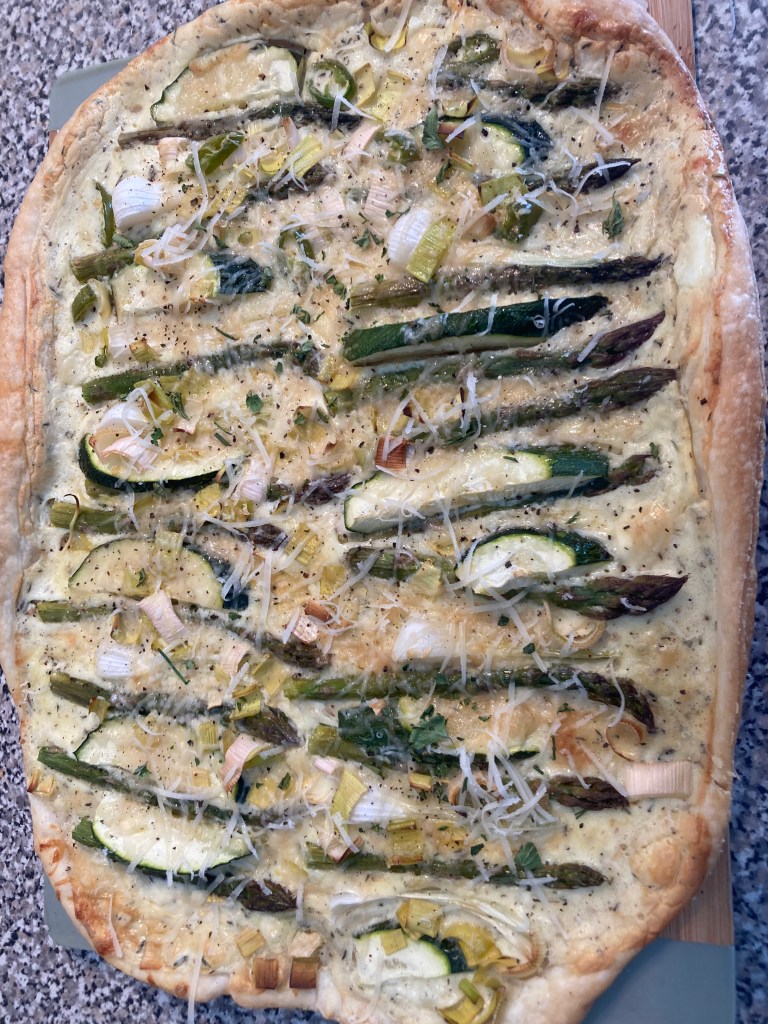
Spring means asparagus, We don’t eat asparagus the rest of the year because it is just not worth eating; fresh local asparagus is such a treat. At the risk of offending my French friends, I do proclaim that Washington, USA grown asparagus is superior, but the stalks from France are quite nice.

One of the wonderful conveniences at the Supermarché are the premade doughs and crusts. They come in a package rolled around paper. To use you simply unroll the dough onto your baking sheet and you are set. For this tart I used puff pastry dough.

The first layer was crème fraîche. Then asparagus, leek, and sliced zucchini. It was seasoned with a bit of salt and red pepper flakes. (Yes, I do put a bit of red pepper flakes on most everything. Not enough to make it spicy, but even a bit enhances the flavor better than black pepper.) I topped it off with grated Parmesan cheese and baked.

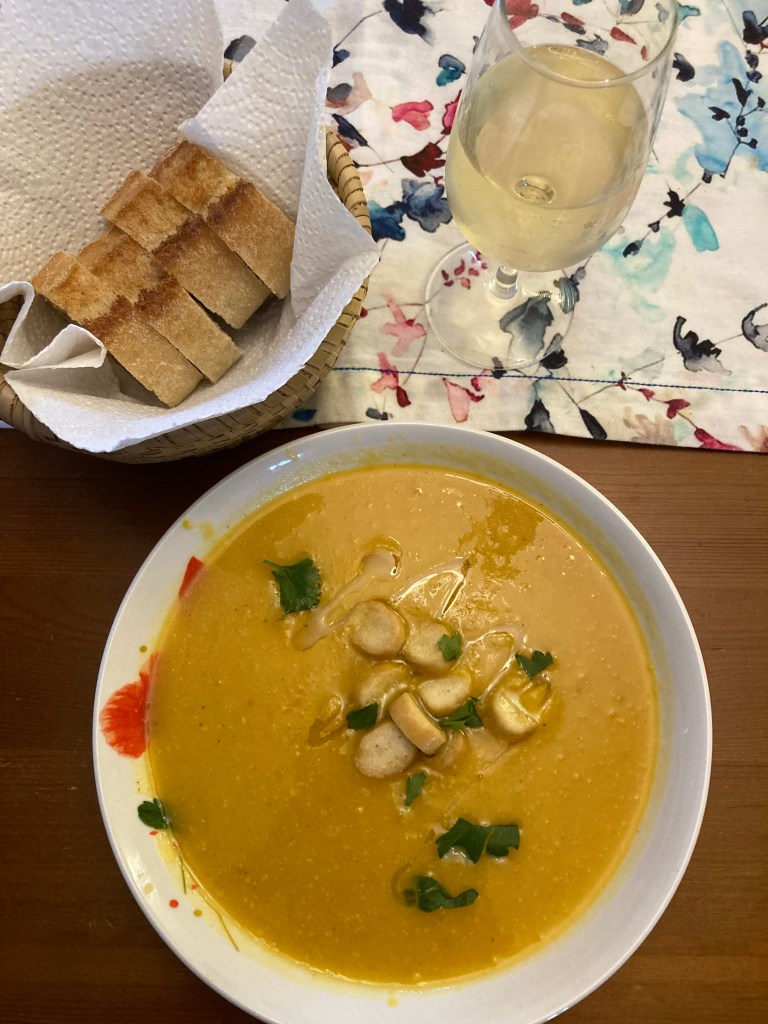
In March 2022 we were in Paris on our way home from Faro, Portugal. We stayed for a few days at a newer hotel in the Montparnasse area, The Drawing House. A great place to stay if you want to try something with a real art vibe. It was late so we just ate in the hotel. Tricia had curried squash soup, which inspired her to do her own version at Chez Moi.

She topped it with mini-croutons, and a drizzle of olive oil. From my totally biased objectivity it was better than at the restaurant. Some slices of baguette and a glass of vin blanc made the perfect meal.

Cooking and eating has been an integral part of our life for as long as I remember. It is our hobby. Food brings us joy, which, when we get the opportunity, we love to share with friends and family.

A Week of Food and Friends

Tricia and I are foodies; we talk about food, we plan our next meals while eating, and we both read food blogs. When we travel, seeking out a good place for lunch is as important to us as visiting some iconic sight. Thankfully, our friends Tim and Lisa enjoy good food as well, so their time with us has included varied venues, both geographically and culinarily. Thank you Tricia for most of these photos.

Not all of our meals were in restaurants. Sandwiches, or paninis, which of course are the same thing, but panini sounds more exotic, were a mainstay. Lisa with her comfortable stalwart of sliced turkey, Tricia with tomatoes and sliced goat cheese. Tim and I had sardine salad with spices, onions, and pickles. One day we had grain bowls, a welcome vegetarian break from meat-heavy French cooking.

Sundays were at home, since open restaurants on Sundays in France are not common in the rural areas. Sunday Lunch is a revered tradition in France which I suppose contributes to the restaurants being closed. We cooked breaded chicken one Sunday, braised lamb and mash the second.

We visited a number of restaurants, Saint Julien’s twice. We went with Tim on his first day here. Last Tuesday all four of us went.

Menu du jour at Saint Julian’s

We had Indian food in Mayanne. We even went to the Buffalo Grill to have American-style hamburgers. One night our neighbors invited us over for the UK version of chili, which is not Tex-mex at all, yet was quite good.

Last Wednesday we went to Au Point Nommé  in Saint-Fraimbault. Tricia and I went there in March of 2020 when we were here to check out La Thebauderie, it was good to go back. We sat in the sun and enjoyed the meal.

On Thursday we took a long drive to Granville, a historic town and the location of one of our favorite restaurants in Normandie, La Citidel. The lunch was a gift to us all from Lisa’s mom who lives in far away Southern California. We enjoyed every moment, sitting outside under an awning that gave some of the photos an orange tint. Thank you so much Anne.

Apéros and oysters for a perfect start to a meal by the sea.

Tricia had scallops, what an amazing presentation. Tim and I had seafood towers.

Friday we took them to our favorite place nearby, which I have written about before, Auberge du la Source – wonderful, c’est normal.

It has been a good time. Thursday we all head for Chartres to visit the famed cathedral. Of course, as iconic and historic as the Gothic church is, Tricia and I will be in search of good food.

I Needed a Burger, in France

Thirty six years ago this month I went on a date with the lady who would become my love, the mother of our wonderful daughter, my best friend, as well as my travel and food buddy. We have made it through the ups and downs of any relationship yet we still love to eat and travel together. Today I had my first real hamburger in over 16 months – before we moved to France.

When we moved to France we did so with the intention of embracing the culture, and we have done so quite well. Our UK friends still have people bring them beans and brown sauce from the UK, we have only asked for red pepper flakes and Panko. We strive to eat what is here, though we do make nachos at home now and then. But we live in another country, one that is known for its food, which we accept and enjoy.

One of the challenges of living as rural as we do is that the variety of famous French foods is limited. At even the smallest of cafes the food is done quite well but often without variety. It is the same if you live in rural USA, all the restaurants have similar food, I know as I have traveled there. So we do at times crave different tastes. We go to Mayenne to have Indian food, we get to Paris as often as practical to visit wonderful cafes. But every now and then a food from the past gets into my brain as a craving – a hamburger.

Early in our relationship Tricia, who has a degree in nutrition and food science, told me, “If you are going to have a burger then have the juiciest greasiest one you want, enjoy it, but just don’t do it everyday.” Some folks, when they learn that she has a degree in nutrition, give me their sympathy, thinking we must have an austere diet, au contraire, we eat most everything, but with a bit of balance – frites don’t count of course. So it made sense that when I began to vocalize my craving for a burger she was completely supportive.

The French do eat hamburgers, it is common to see them on menus, even at rather upscale restaurants. McDonalds are relatively common, and it is not because McD has forced themselves on the French. McDonalds is a big business, they would not stay in France if the French were not patronizing their restaurants, the French eat hamburgers.

BUT… Often the burgers I see on the plates of other diners do not look much like what the burgers in the US look like. I did order a burger last summer, the bun was black, not gray, not burned from grilling, but black. I have no idea what kind of flour or process made it that way, I have seen the same at other restaurants. It’s texture was like a macaroon, almost like eating air; defiantly not a genuine burger in my book.

The other interesting difference is that when you see a person eat a burger in France it is almost always with a knife and fork, not picking it up and eating it with your hands. In France most everything is eaten with a knife and fork, even pizza.

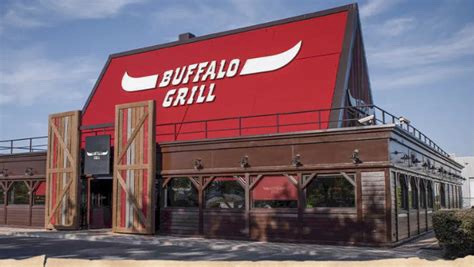
There is a chain of restaurants here in western France that promotes itself as American food, Buffalo Grill. We have driven by them over the year but never stopped, well today we did, in Le Mans.

They have burgers, ribs, chili, even buffalo. So the time and place was right to fill my craving.

I ordered the Extra Cheeseburger – here is the menu description: Steak haché de bœuf façon bouchère ou galette végétale façon chili, cheddar, sauce cheddar, sauce premium, oignon, salade, cornichon. Or, thanks to Google Translate: ground beef steak or vegetable patty chili style, cheddar, cheddar sauce, premium sauce, onion, salad, pickle.

Confusing description aside, it was a genuine American style cheeseburger and I enjoyed every bite – and of course I picked up and ate it properly, with my hands. Tricia had fish and chips, again quite good. So my hamburger craving is satiated for now, and we discovered a place that will work well if we want a taste of non-French cuisine.

I started this blog yesterday, today we are in Montmorillon in the Nouvelle-Aquitaine region of France. We had lunch with friends at a crêperie where I had a galette with chicken and curry sauce, so delicious. French food is great, but every now and then a bit of home comfort is required. We will visit Buffalo Grill again, there is one just 30 minutes away in Flers.

French Eating – Apéro Time

Apéro or Apéritif. In France apéro is just short for apéritif. In the USA an apéritif is an alcoholic beverage enjoyed before a meal, in France it is an event and one of the most enjoyable components of the meal, at home or out.

The closest concept in the USA to the French apéro would be a happy hour. In the USA happy hour translates to reduced prices on snacks and beverages, along with a gathering of friends. In France apéro is a time to relax with friends before a meal, or as in the USA, gather with friends for a chat. You do not see “apéro” signs in front of restaurants here, though you do see “Happy Hour” signs in a few places that cater to tourists. Why would you advertise something that is just considered the norm?

You order a beverage, the food is a surprise. Whole blogs have been more knowledgeably written by others on common apéritifs in France. Beer, wine, and Champagne are frequent, though our personal favorite is a kirkir pétillant is sparking wine flavored with something like cassis or peach, kir normand is cider similarly flavored, both are quite enjoyable. A kir with Champagne is quite good, but the price goes up a lot.

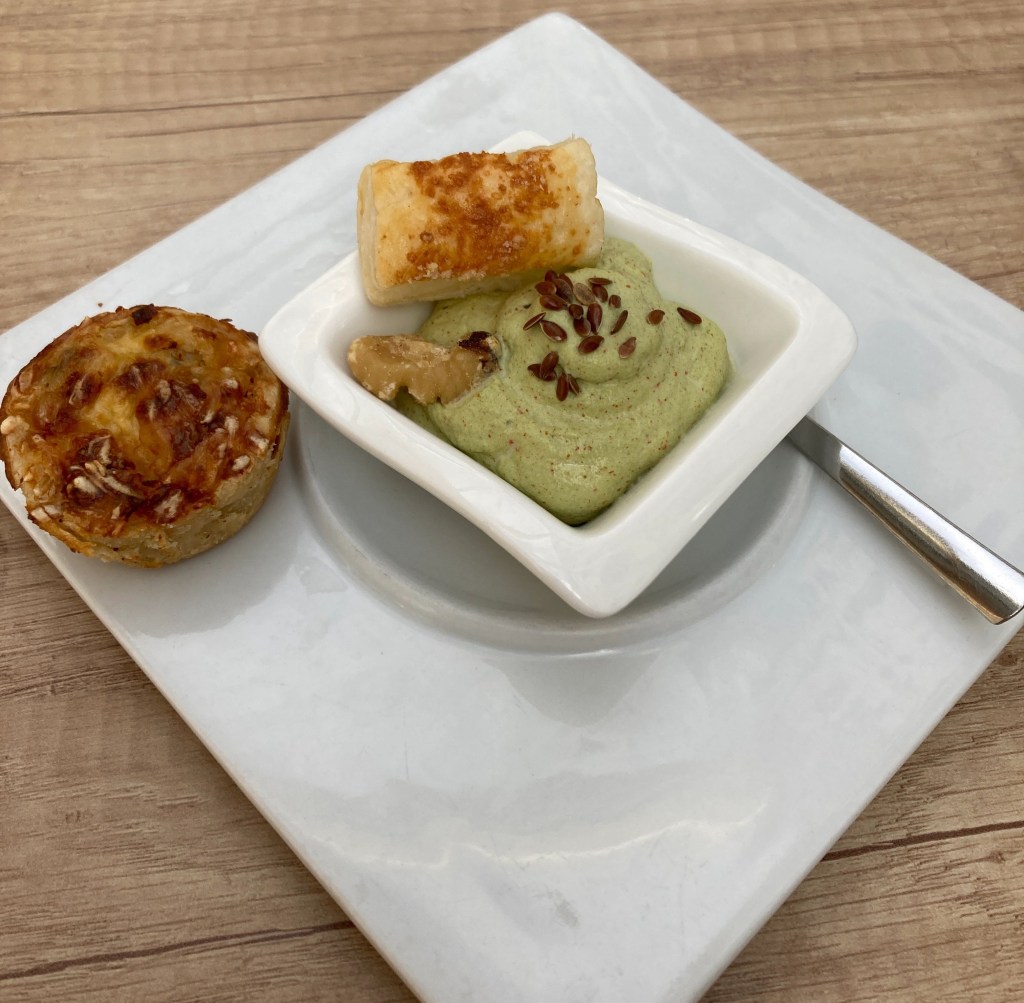
When they bring the beverages they also bring a snack of some kind, also called an apéro. This could be as simple as a few nuts or pretzels, or as elaborate as this apéro that we had last week at Auberge de la Source, one of our favorite places just 20 minutes away in the tiny village of Saint-Cyr-du-Bailleul.

You are not charged extra for the tasty treat, it is expected. This had a mini-quiche Lorrain, a savory mousse that must have had a bit of smoked paprika, and a small puff pastry with a light coating of cheese. The chef here is international, and one of the best.

The apéro tradition is quite as prevalent at home. La supermarché has whole sections, both fresh and frozen, of small bites suitable for apéro. For us this is so perfect. Our main meal of the day is lunch, which in itself is quite French, I have written before regarding how lunch is a sacred time here. We rarely have a traditional evening meal, it is just too much food. So we have an apéro at home: store bought, made ourselves, or a bit of cheese and baguette.

Apéro is just one of the ways we have learned the wonderful custom of slowing down when it comes to food. In larger cities you do find crepes and sandwiches to take away and eat on the go, but slowing down to enjoy a meal is most desired, and we have adapted quite well. C’est la France!

An Expat’s Struggles With Ordering Food

The stereotype for many in the USA is that the French are not friendly, well after multiple trips to France, and living in France for a year I can say that is just not true. In general the French are so kind and helpful. When we butcher their beloved language they may correct a bit but most often they encourage our efforts. Sometimes they are too helpful, particularly when it comes to food.

Now before I continue a DISCLAIMER is in order. I enjoy my British friends and their quirky language, we all get to laugh over terms and pronunciations. However my eating preferences are not British and therein is the problem. In an attempt to cater to our tastes, as they (the French) perceive them, they often make adjustments to my order that don’t work for me.

In my last blog I alluded to one of those adjustments, ordering le café. In one hotel they actually brought me a mug of coffee from a 12 cup coffee maker common to most homes in the USA. Other times I say, “Je voudrais un café, SVP,” the server pauses for a minute then asks if I mean an espresso, a question they would never ask a French person. It comes from their experience of bringing an English speaking person a French le café and having the customer unhappy because they wanted a mug of drip or at least an americano – like I said the French are so helpful most of the time.

Second DISCLAIMER. When it comes to anything bureaucratic that help may be hard to come by – this post is all about food.

The French are carnivores, big time. Vegetarians often struggle, though we are seeing some changes making it easier. Meat preferences in France are often quite foreign to US or UK diners.

When it comes to le boeuf they like it rare, really rare. The go-to degree of doneness is bleu, which, just as it sounds, means blue. The piece of meat is seared for no more than 30 seconds on a side and served. For most UK and USA folks they see this and say it is raw, which of course it pretty much is. Here is a photo of one such steak I had when we were with our friends in L’Isle-sur-la- Sorgue.

The next degree of doneness is sanglant which literally means bloody, this would be extra rare in most restaurants in the USA, it is my normal way to order here. Yet what often happens is the server questions me, “medium?” Or the cook just cooks it so there is barely any pink at all. You see the Brits tend to like meat well done, which is considered unthinkable to the French, and to me as well, so like with the coffee they often adjust.

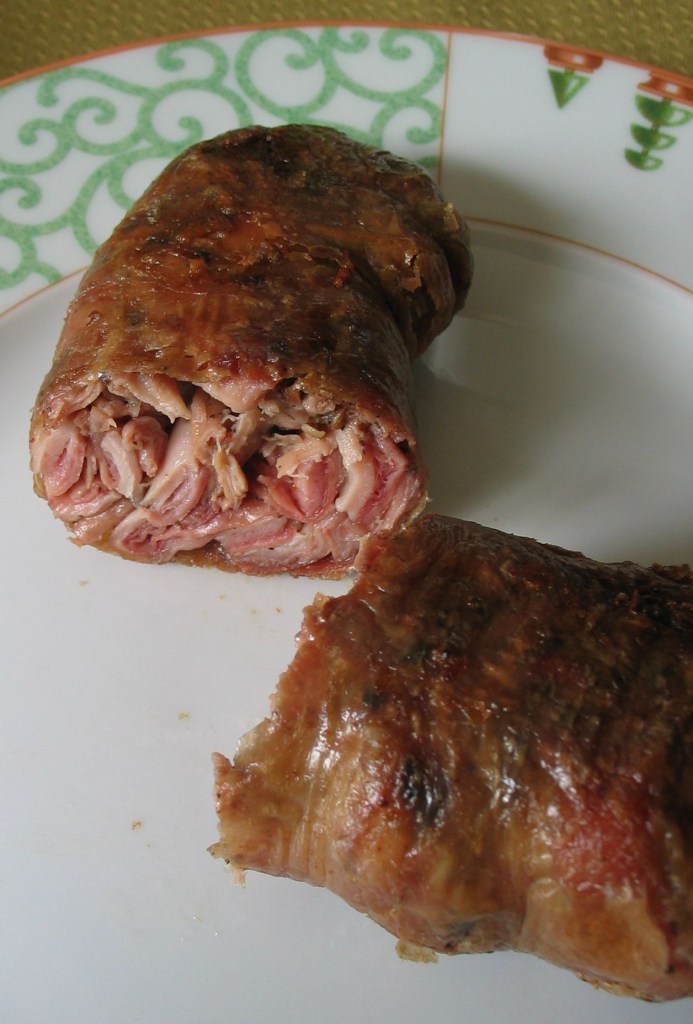
Here in Normandie andouillette, not to be confused with the spicy, smoked andouille from Cajun Louisiana, is on most menus. Here are photos of both.

French andouillette are made from pork large intestines, spices, grains, and onions. They are quite corse compared to the Cajun smoked sausage. Wikipedia says, Andouillettes are generally made from the large intestine and are 7–10 cm (2 3/4 – 4in) in diameter. True andouillettes are rarely seen outside France and have a strong, distinctive odour coming from the colon. Although sometimes repellent to the uninitiated, the scent is prized by its devotees.

The first time I ever ordered andouillette the owner of the open-fired grill restaurant tried to talk me out of it. He said that Americans don’t eat this. I assured him I did. With mustard sauce it is quite OK on occasion. On other occasions the server has asked if I know what andouillette is, or if I am sure. I know they are trying to be helpful, but I also know this expat is not like all the others.

A third challenge here is finding spicy food. With the exception of mustard, which is always Dijon, the French don’t eat much that is spicy. We wanted some salsa, they have Old El Paso, the same brand as we could get in US, but it only comes in mild and extra mild. I can’t imagine what extra mild would be, tomato sauce???

Soon after we moved here we discovered an Indian restaurant not too far away, craving a bit of spicy food we went. It took us a few visits for me to convince the very nice server, that we have come to know well, that when I asked for spicy I meant spicy. In fact last time he actually brought something out that was too spicy for me, that is rare. Yet he is so used to compensating for the French palette that he just naturally tones things down.

In all my years of travel I have attempted to eat like the locals do. I am not like Tony Bourdain was, nor Andrew Zimmern, there are some limits, but in general I say give it a go. Often I end up liking things that might put some folks off, that is one of the joys of travel, and this expat loves the journey of food.

I guess I do agree with Zimmern when he says, “If it looks good, eat it.”

Un Café – The Price of Admission

In France un Café is more than a beverage, it is the cornerstone of the café culture. In the USA coffee is something you do while you do something else, in France it is much more deliberate, for a traveler it is a perfect entry into the local culture.

I have never seen a drive-through Starbucks in France; the drive through food and beverage concept is as rare here as it is ubiquitous in the USA – as are insulated travel cups. In France you stop what you are doing to have un café. The Dunkin Donut idea of unlimited refills is just as strange, as would be a “grande” or “venti” size. These are uniquely American concepts where quantity often supersedes quality.

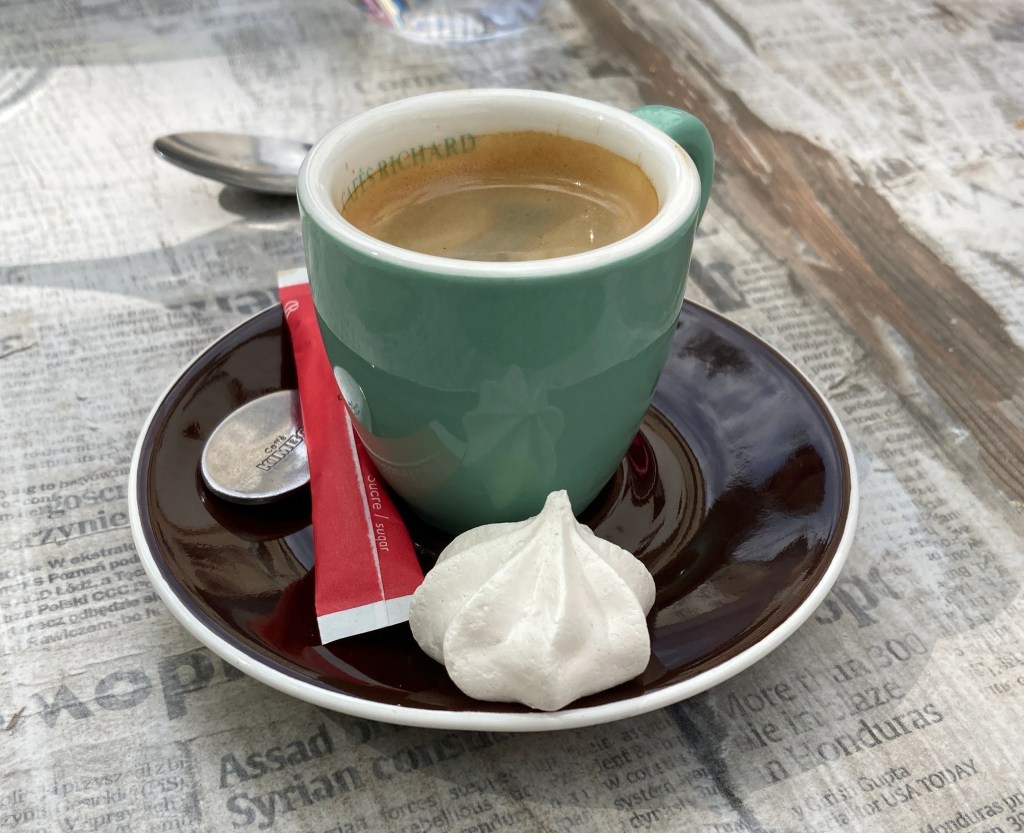
In France this is un café

In its most basic form it is a shot of espresso, always served in a cup and saucer, with a small spoon, sugar – never cream – and a petit biscuit. There are other drinks that are only coffee: un double which is two shots served the same way, un café allongé which is a single with more water forced through, and an americano which is espresso diluted with hot water to cater to the taste of Americans in WWII that found un café to strong – an americano is as close as you will get to a mug of coffee in France. One of my favorites is un café noisette which is an espresso with just a dollop of steamed milk.

One of my frustrations is that often when I order un café, with my best attempt at a French accent, they will either bring me an americano, or clarify that it is espresso I want, as they are so accustomed to folks from UK and USA not wanting a real un café.

In France coffee with milk is rarely consumed after early morning, having a latte in the afternoon clearly signals you are from Starbucks country. Un café is the norm after a meal, but of course without milk.

Un café is also your ticket into the café culture, you can sit for hours at a table, with no one implying that you need to give up your table, participating in the French pastime of people watching, or in my case sketching.

Le café and les cafés are one of the things I like the most about France. Whenever possible I go early and enjoy starting my day watching, sipping, and sketching.

Manifestations and Menu du Jour

Menu Blackboards, about A4 size (8.5×11.5 inches), for setting on a table, or 2×3 feet for leaning up on the floor next to a chair, or as an a-frame next to the entry of the restaurant are the ubiquitous icons of French dining, as is the Menu du Jour which is chalk-written on them each morning. With a reputation for the best food France is obsessed with normalcy.

Photos courtesy of Tricia and Travels Through My Lens

A Menu du Jour has three courses: entree, main, and dessert. There may be a choice in each course of two or three items, but the menu is pretty well fixed. Many restaurants will have other menu offerings, but if you observe the locals they tend to order the Menu du Jour, or the Plat du Jour which is simply one of the mains. Why? Because the French are obsessed with normalcy, deviation can result in manifestations – or protest. The stability must not be threatened.

French food is most always done well regardless of the price. We have had quite good meals at obscure, mundane establishments. However there is always predictability. Fridays will have fish, though the country is officially secular according to the constitution, the centuries of Catholicism still are considered normal, even for the majority who never enter a church. The menu will have mostly meat mains, except for Friday, as the French are carnivores, some think fish counts as a vegetarian meal. For dessert you can almost bet there will be chocolate mousse, even if other more creative offerings share the blackboard.

There is good, even great, food to be found and it is worth the search. One such place was Chez Dumonet, an old resturant in Paris where we ate in December – yet even they had a prix fix menu – because the three courses are expected – normalcy.

Lunch is sacred, it is a long and slow affair, even in rural areas with a clientele of farm or construction workers; no sandwich in the cab of a pick-up truck here. Normalcy. There is even a law, though relaxed during COVID, forbidding eating lunch at your desk. Lunch is sacred, normalcy, don’t rock the boat.

Yet even a cursory glance at the history of France makes it clear that it has never been a stable country. For much of its history France was really just Paris, the rest of the country was run by dukes and such who ignored the king and spent their time fighting with each other while taxing their subjects. The famous French Revolution was not some break from tyranny resulting in a government by the people; just a short time later Napoleon was a dictatorial emperor. It was not until the 1900’s that the France we see today began to emerge, and even that was disrupted with occupation by neighboring Germany.

Today the French cling to stability, protecting established practices and institutions. When these are threatened by new laws or programs manifestations are soon to follow. Street closures are even posted on days when a protest is expected, and the Parisian response is “C’est France.”

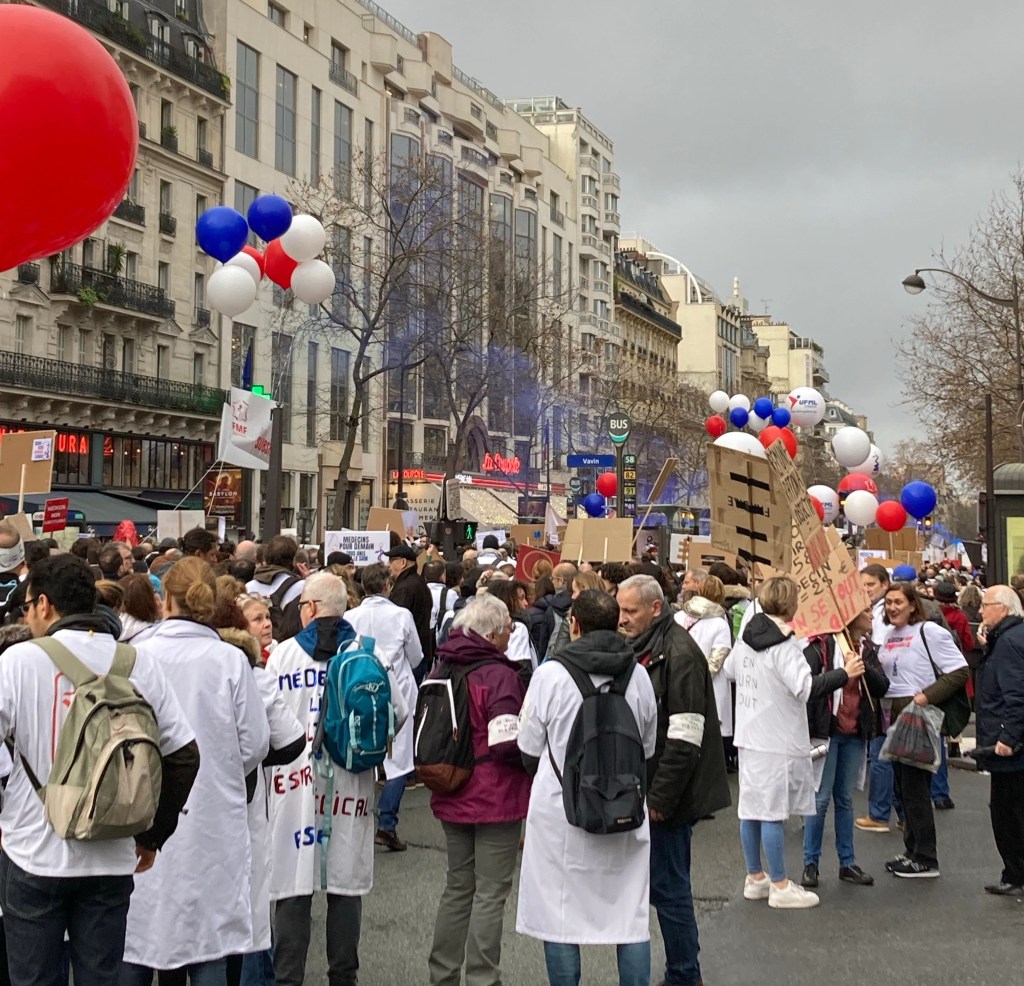
Tricia took this photo of a protest when we were in Paris in January – Healthcare workers.

As I write, protests are happening in major cities, for the second week in a row, with another “General Strike” planned for Saturday, because the government wants to raise the retirement age from 62 to 64. The railways and Metro are shut down, a million people marched along the Champs-Élysées, some turned violent resulting in teargas and broken shop windows. Don’t mess with the normalcy of the earliest retirement of any industrial country.

Yet you can be sure that the restaurants not on the parade route have their blackboards set up, even protesters need a sense of normalcy and where better to find it than over a predictable meal and a glass of wine, ok maybe two glasses, but it is also true that over drinking at lunch is not a French thing. Normalcy.

Though France can be quite tolerant, there is also an undercurrent of selfishness. Shutting down the transportation system does make a statement to the government, but it totally disrupts the lives of millions.

Twice we have had to make major travel changes due to the railway strikes. And with our daughter coming to visit us next week we are concerned about another strike since they are taking the train from Paris Montparnasse, which seems to be protest central, to Flers in Normandy. If the train is shut down we will have no stability and even the best blackboard menu will not make it normal.

Cruise Ship Food – a Bellcurve

Cruise ship overeating is legendary, even Rick Steves suggests using the stairs as much as possible to burn off the calories, but what is the food really like? In general, on land or on the sea, a restaurant’s food quality fits a perfect bell curve – the more people they try to serve and/or the more locations they operate, the more they approach the mediocrity-of-average, not bad, just not great.

Disclaimer: we have only been on two cruises, both operated by Norwegian Cruise Line, so my observations are limited to the two ships we were on. One ship was the Epic, a huge ship, the second cruise was on the Sun, which carries half as many people, there are however a lot of similarities between the two.

There are three categories of onboard dining experiences. Included in your basic cost are the buffets, and a couple of table-service restaurants. The third category is the a la carte restaurants. Each of these are quite different.

On Norwegian (NCL) The Garden Cafe, along with a couple of smaller buffets usually near the pool area, is standard. These are open from early in the morning until well into the evening, changing the offerings from breakfast, to lunch, to dinner. I think a majority of the folks onboard eat most of their meals here.

On the plus side is that there are a lot of choices, from grab-and-go, to prime rib. But the quality is always mediocre, and at breakfast a crowd of people, often pretty aggressive people, jam the place; no relaxed morning coffee and croissant here – though the croissants are quite good. For folks in a hurry, or those who tend to eat because it is required to live and quantity is more important than quality, these buffets are fine. Again, they are not bad, but as with most buffets, just not memorable.

On our most recent cruise aboard the Norwegian Sun there were two table service restaurants that were included with our basic booking: The Seven Seas and The Four Seasons. Both have the same menus which change every day. They are white tablecloth, there is a sommelier, and great servers – nothing fast-food about them at all.

These restaurants are quite a few notches above the Garden Cafe, being the food-motivated-travelers we are, this is where we ate most often. They are not open for lunch so if we were onboard our only choice was the Buffett. Tricia had some good soups: spinach, cauliflower. The entrees (appetizers for non-European readers) were quite nice, and the mains (entrees for non-European readers) were varied and done well. They definitely move the quality of food and dining experience to the right of average on the bell curve.

The third option is the a la carte places, we bought a package in advance that gave us two visits, you can buy packages with more visits, or you can just go and pay as in any restaurant. On both ships Le Bistro was the top restaurant, a bill there for two including wine would be about $150, similar to what we would experience in Seattle. On this ship there were a couple of steak houses, a Mexican cantina, teppanyaki, and sushi.

These restaurants do give a fine dining experience, though they will push your budget significantly above the initial cost of the cruise. The service is always well above average, and if you get there early you can usually score a table by a window to watch the water go by as you dine.

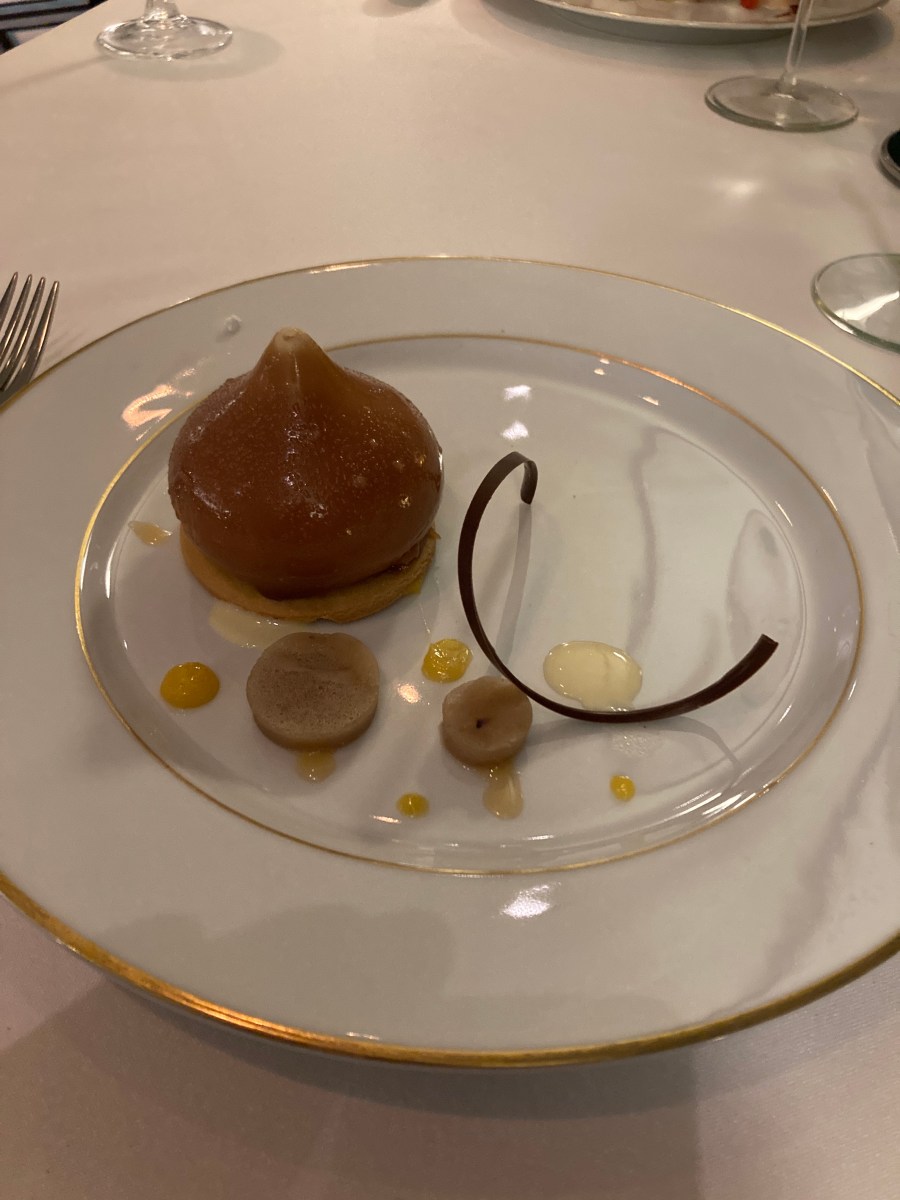
My desert at Le Bistro on the Norwegian Sun just a week ago, quite nice.

Here are photos Tricia took of some of the dishes we enjoyed. (Be sure to visit her blog for more photos)

We ate well, avoided the Garden Cafe when we could, which should come as no surprise to those who know me since I am not a fan of any buffet, on land or sea. On NCL you can have average meals, good meals, and really good meals, but you will pay for the really good ones. In the end I don’t think I would go on this type of cruise for the food. If food is one of your prime reasons to travel, as it is for Tricia and me, other options for travel are a better choice than cruising – though I have heard of gourmet cruises, hmmmm?