In France un Café is more than a beverage, it is the cornerstone of the café culture. In the USA coffee is something you do while you do something else, in France it is much more deliberate, for a traveler it is a perfect entry into the local culture.
I have never seen a drive-through Starbucks in France; the drive through food and beverage concept is as rare here as it is ubiquitous in the USA – as are insulated travel cups. In France you stop what you are doing to have un café. The Dunkin Donut idea of unlimited refills is just as strange, as would be a “grande” or “venti” size. These are uniquely American concepts where quantity often supersedes quality.
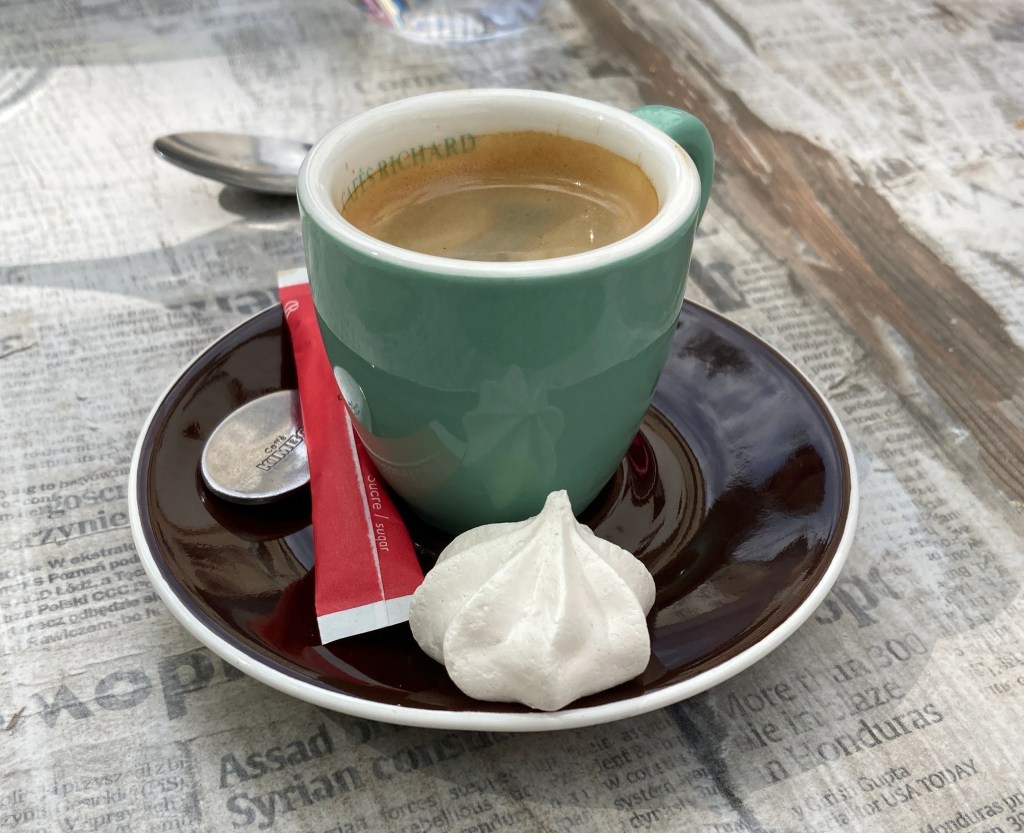
In France this is un café
In its most basic form it is a shot of espresso, always served in a cup and saucer, with a small spoon, sugar – never cream – and a petit biscuit. There are other drinks that are only coffee: un double which is two shots served the same way, un café allongé which is a single with more water forced through, and an americano which is espresso diluted with hot water to cater to the taste of Americans in WWII that found un café to strong – an americano is as close as you will get to a mug of coffee in France. One of my favorites is un café noisette which is an espresso with just a dollop of steamed milk.
One of my frustrations is that often when I order un café, with my best attempt at a French accent, they will either bring me an americano, or clarify that it is espresso I want, as they are so accustomed to folks from UK and USA not wanting a real un café.
In France coffee with milk is rarely consumed after early morning, having a latte in the afternoon clearly signals you are from Starbucks country. Un café is the norm after a meal, but of course without milk.
Un café is also your ticket into the café culture, you can sit for hours at a table, with no one implying that you need to give up your table, participating in the French pastime of people watching, or in my case sketching.
Le café and les cafés are one of the things I like the most about France. Whenever possible I go early and enjoy starting my day watching, sipping, and sketching.
Menu Blackboards, about A4 size (8.5×11.5 inches), for setting on a table, or 2×3 feet for leaning up on the floor next to a chair, or as an a-frame next to the entry of the restaurant are the ubiquitous icons of French dining, as is the Menu du Jour which is chalk-written on them each morning. With a reputation for the best food France is obsessed with normalcy.
A Menu du Jour has three courses: entree, main, and dessert. There may be a choice in each course of two or three items, but the menu is pretty well fixed. Many restaurants will have other menu offerings, but if you observe the locals they tend to order the Menu du Jour, or the Plat du Jour which is simply one of the mains. Why? Because the French are obsessed with normalcy, deviation can result in manifestations – or protest. The stability must not be threatened.
French food is most always done well regardless of the price. We have had quite good meals at obscure, mundane establishments. However there is always predictability. Fridays will have fish, though the country is officially secular according to the constitution, the centuries of Catholicism still are considered normal, even for the majority who never enter a church. The menu will have mostly meat mains, except for Friday, as the French are carnivores, some think fish counts as a vegetarian meal. For dessert you can almost bet there will be chocolate mousse, even if other more creative offerings share the blackboard.
There is good, even great, food to be found and it is worth the search. One such place was Chez Dumonet, an old resturant in Paris where we ate in December – yet even they had a prix fix menu – because the three courses are expected – normalcy.
Lunch is sacred, it is a long and slow affair, even in rural areas with a clientele of farm or construction workers; no sandwich in the cab of a pick-up truck here. Normalcy. There is even a law, though relaxed during COVID, forbidding eating lunch at your desk. Lunch is sacred, normalcy, don’t rock the boat.
Yet even a cursory glance at the history of France makes it clear that it has never been a stable country. For much of its history France was really just Paris, the rest of the country was run by dukes and such who ignored the king and spent their time fighting with each other while taxing their subjects. The famous French Revolution was not some break from tyranny resulting in a government by the people; just a short time later Napoleon was a dictatorial emperor. It was not until the 1900’s that the France we see today began to emerge, and even that was disrupted with occupation by neighboring Germany.
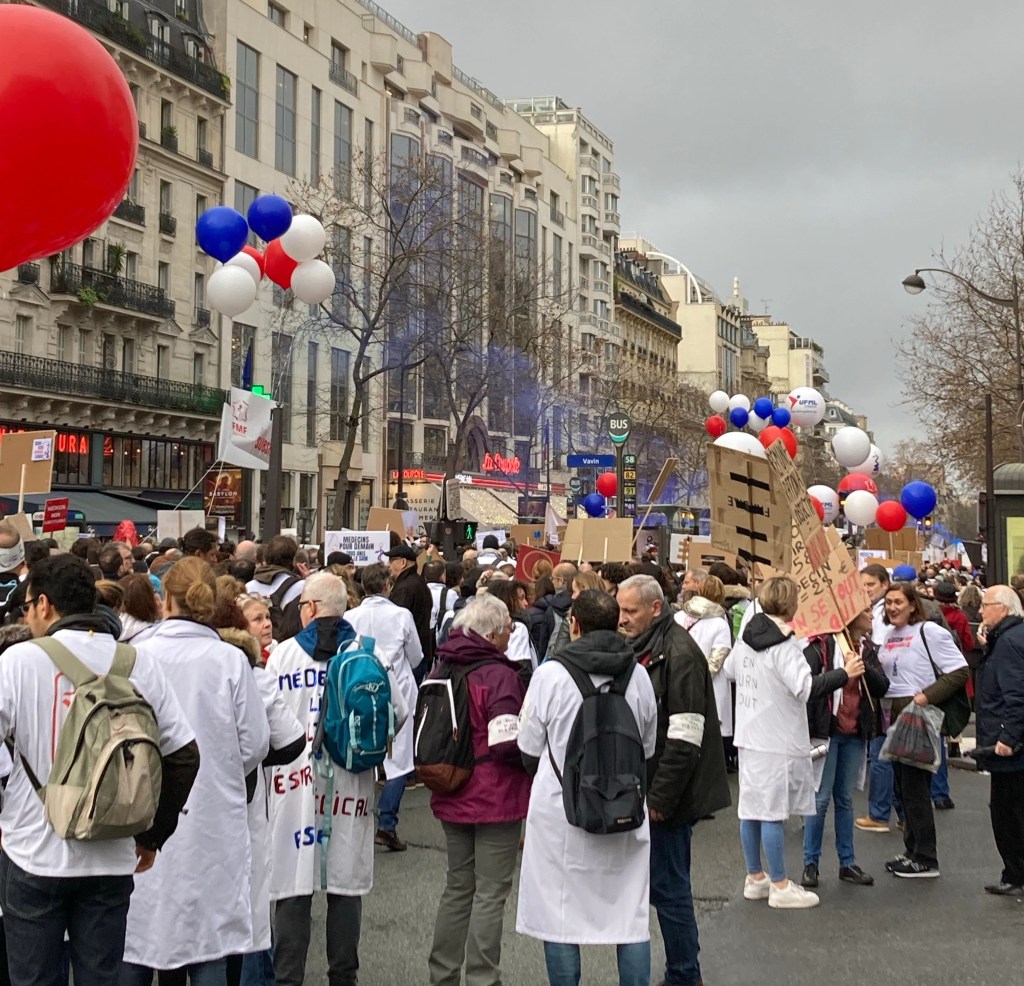
Today the French cling to stability, protecting established practices and institutions. When these are threatened by new laws or programs manifestations are soon to follow. Street closures are even posted on days when a protest is expected, and the Parisian response is “C’est France.”
Tricia took this photo of a protest when we were in Paris in January – Healthcare workers.
As I write, protests are happening in major cities, for the second week in a row, with another “General Strike” planned for Saturday, because the government wants to raise the retirement age from 62 to 64. The railways and Metro are shut down, a million people marched along the Champs-Élysées, some turned violent resulting in teargas and broken shop windows. Don’t mess with the normalcy of the earliest retirement of any industrial country.
Yet you can be sure that the restaurants not on the parade route have their blackboards set up, even protesters need a sense of normalcy and where better to find it than over a predictable meal and a glass of wine, ok maybe two glasses, but it is also true that over drinking at lunch is not a French thing. Normalcy.
Though France can be quite tolerant, there is also an undercurrent of selfishness. Shutting down the transportation system does make a statement to the government, but it totally disrupts the lives of millions.
Twice we have had to make major travel changes due to the railway strikes. And with our daughter coming to visit us next week we are concerned about another strike since they are taking the train from Paris Montparnasse, which seems to be protest central, to Flers in Normandy. If the train is shut down we will have no stability and even the best blackboard menu will not make it normal.




 Been There, Eating This