La cuisine chez nous, II

Started my day a bit off, but then, on the way to the Intermarché, Tricia reminded me that she was making pasta for lunch, it completely brightened my day; food is so important to us and our frame of mind. So now, thoroughly rejuvenated, I am writing while she is creating one of the best comfort foods in my life. I know we will be in Italy in eleven days – after stops in Paris, Lyon, and Geneva – yet her pasta is what has my attention today.

These last few weeks in Normandie we have eaten well, see my blog “La cuisine chez nous. Since that post I wanted to report on the state of la cuisine chez nous.

We have gone out to Le Bistrot St Julien, it remains our favorite in the area. We also went to Auberge de la Source, another of the places we like, in fact it seems we rarely go anyplace else. The entree, a basted egg in a camembert sauce with bits of andoulette, was stunning.

We have both admitted that when we are home we would rather eat at Chez Nous, and eat we did. Tricia did the shepherd’s pie that I wrote about on my last post, since then she has posted the recipe, give it a try. For a Sunday lunch I made compte gougères for and entree, then Mushroom Bourgogne with polenta for the mains.

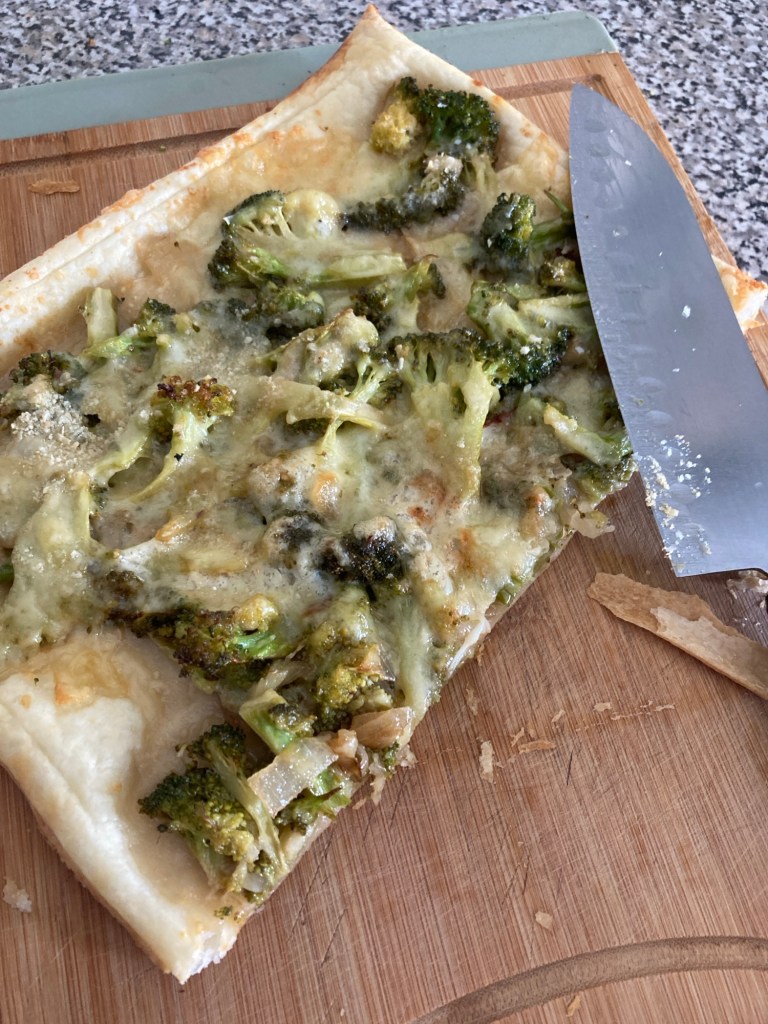
One of my other contributions was broccoli and compte on puff pastry. This one is defiantly a do again, unless of course our friend Dave is near, he calls broccoli “sticks of death”, not his favorite veggie.
Tricia followed this with another of the comfort foods she does so well, sole meuniere. She has never posted the recipe but since it is a classic French dish you can certainly find it with an online search. It is one of those dishes that can seem intimidating, but there are simple versions. The caper sauce is what makes the dish, so rice pilaf was the perfect accompaniment.

Saturday I made crab cakes for the main,

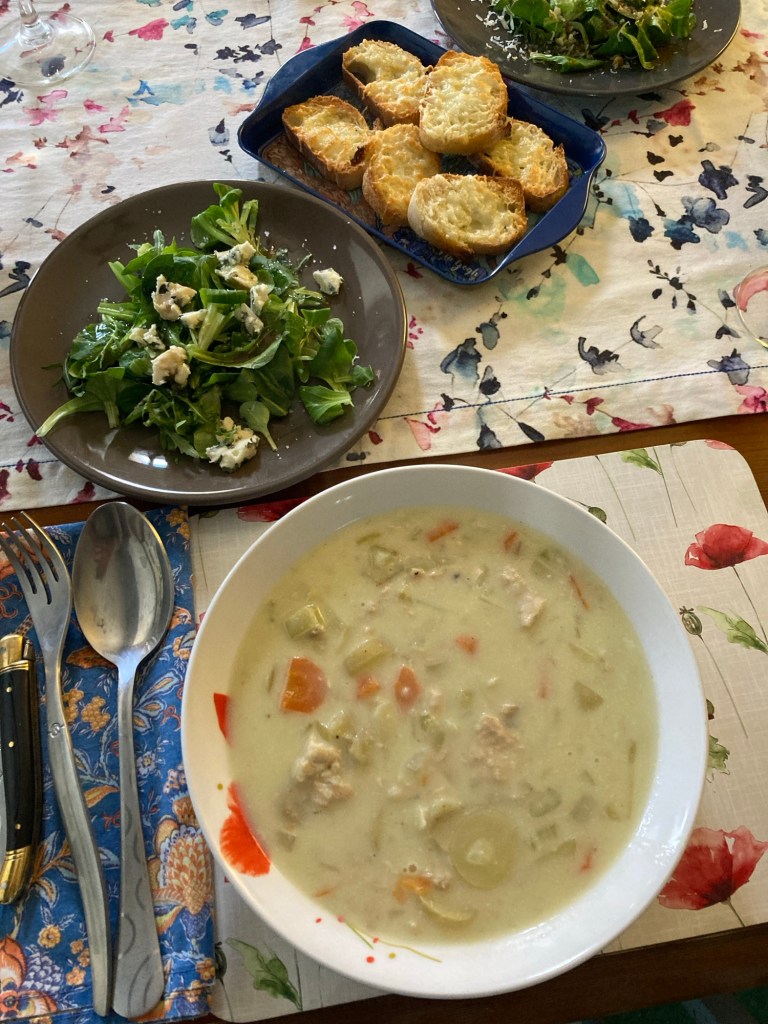
Yesterday for Sunday lunch Tricia made salmon chowder which I had with spicy coleslaw. I made parmesan shortbreads for the entree- the only entree easier than the compte gougères which I made earlier. Someday I must post the recipe as they are always a hit with guests, and easy to take when visiting. To complete the meal I made Parmesan toasts, and a roquefort salad.
When I started writing Tricia was making pasta. Most often our pastas are vegetarian, Tricia loves a lot of veggies, thankfully I do as well. We cook some pretty hardy meals with vegetables, nothing wimpy about them at all. Here is the finished dish.

So it has been a good few weeks here in Torchamp, we head out on Thursday for the train in Flers which will take us to Paris and then onward. Lots of trains on this trip, one through the alps between Geneva and Milan that I am particularly looking forward to.

We are grateful that we live in a place where travel is easy and much more affordable than in the US. Yet we have always traveled, even just day trips driving around the Pacific Northwest, or here in Normandie. The important thing for aging joints and healthy attitudes is to keep moving, I even read just this morning that moving reduces the chance of dementia. Some days I can’t remember much of anything, so we need to keep moving, and we will.

I hope your journeys are a joy, short or long. And look for good food along the way.

An Expat’s Struggles With Ordering Food

The stereotype for many in the USA is that the French are not friendly, well after multiple trips to France, and living in France for a year I can say that is just not true. In general the French are so kind and helpful. When we butcher their beloved language they may correct a bit but most often they encourage our efforts. Sometimes they are too helpful, particularly when it comes to food.

Now before I continue a DISCLAIMER is in order. I enjoy my British friends and their quirky language, we all get to laugh over terms and pronunciations. However my eating preferences are not British and therein is the problem. In an attempt to cater to our tastes, as they (the French) perceive them, they often make adjustments to my order that don’t work for me.

In my last blog I alluded to one of those adjustments, ordering le café. In one hotel they actually brought me a mug of coffee from a 12 cup coffee maker common to most homes in the USA. Other times I say, “Je voudrais un café, SVP,” the server pauses for a minute then asks if I mean an espresso, a question they would never ask a French person. It comes from their experience of bringing an English speaking person a French le café and having the customer unhappy because they wanted a mug of drip or at least an americano – like I said the French are so helpful most of the time.

Second DISCLAIMER. When it comes to anything bureaucratic that help may be hard to come by – this post is all about food.

The French are carnivores, big time. Vegetarians often struggle, though we are seeing some changes making it easier. Meat preferences in France are often quite foreign to US or UK diners.

When it comes to le boeuf they like it rare, really rare. The go-to degree of doneness is bleu, which, just as it sounds, means blue. The piece of meat is seared for no more than 30 seconds on a side and served. For most UK and USA folks they see this and say it is raw, which of course it pretty much is. Here is a photo of one such steak I had when we were with our friends in L’Isle-sur-la- Sorgue.

The next degree of doneness is sanglant which literally means bloody, this would be extra rare in most restaurants in the USA, it is my normal way to order here. Yet what often happens is the server questions me, “medium?” Or the cook just cooks it so there is barely any pink at all. You see the Brits tend to like meat well done, which is considered unthinkable to the French, and to me as well, so like with the coffee they often adjust.

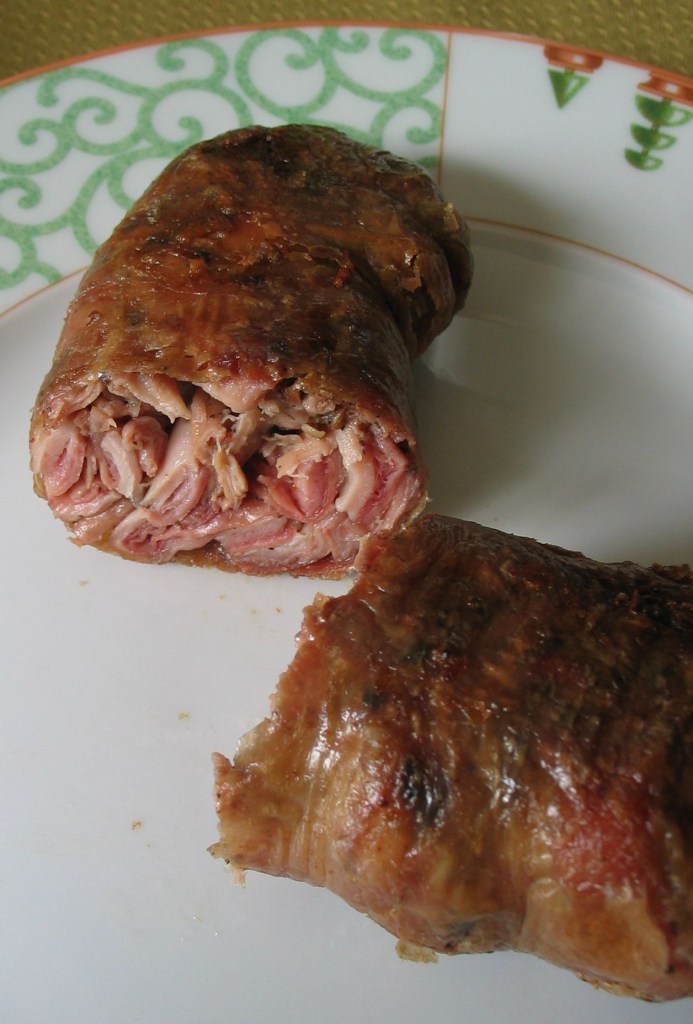
Here in Normandie andouillette, not to be confused with the spicy, smoked andouille from Cajun Louisiana, is on most menus. Here are photos of both.

French andouillette are made from pork large intestines, spices, grains, and onions. They are quite corse compared to the Cajun smoked sausage. Wikipedia says, Andouillettes are generally made from the large intestine and are 7–10 cm (2 3/4 – 4in) in diameter. True andouillettes are rarely seen outside France and have a strong, distinctive odour coming from the colon. Although sometimes repellent to the uninitiated, the scent is prized by its devotees.

The first time I ever ordered andouillette the owner of the open-fired grill restaurant tried to talk me out of it. He said that Americans don’t eat this. I assured him I did. With mustard sauce it is quite OK on occasion. On other occasions the server has asked if I know what andouillette is, or if I am sure. I know they are trying to be helpful, but I also know this expat is not like all the others.

A third challenge here is finding spicy food. With the exception of mustard, which is always Dijon, the French don’t eat much that is spicy. We wanted some salsa, they have Old El Paso, the same brand as we could get in US, but it only comes in mild and extra mild. I can’t imagine what extra mild would be, tomato sauce???

Soon after we moved here we discovered an Indian restaurant not too far away, craving a bit of spicy food we went. It took us a few visits for me to convince the very nice server, that we have come to know well, that when I asked for spicy I meant spicy. In fact last time he actually brought something out that was too spicy for me, that is rare. Yet he is so used to compensating for the French palette that he just naturally tones things down.

In all my years of travel I have attempted to eat like the locals do. I am not like Tony Bourdain was, nor Andrew Zimmern, there are some limits, but in general I say give it a go. Often I end up liking things that might put some folks off, that is one of the joys of travel, and this expat loves the journey of food.

I guess I do agree with Zimmern when he says, “If it looks good, eat it.”