Normandie – Or “The French UK”

It is beautiful here in Normandie in the spring. How can you beat a sunset like this one?

For centuries Normandie has attracted foreigners who attempted to make it their own. The earliest residents were pre-historical. They left behind cave paintings and mysterious megalithic monuments. When Julius Cesar invaded in 58 BC there were thriving Celtic tribes. Rome established multiple sites with ruins and names which are still in use.

At the end of the 3rd century AD the Germans came, destroying much of what the Romans had built in what is now Normandie. The Germans were followed by the Viking raids that started in the early 800s. These raids continued for years and eventually the area was called  Normandie, the land of the Normans. Then, a Viking descendent, William the Duke of Normandy, attacked England in 1066, which resulted in Normandy becoming part of England. In 1204 Normandie was freed from English rule and rejoined France. Yet Normandie has never lost its English roots.

These days Normandie is overrun with tourists intent on visiting the D-Day Beaches, Mont Saint Michelle, churches, and sampling the food. Folks from the UK relocate to Normandie in numbers large enough that some villages have more English speaking residents than French speakers. We can go days never speaking French because all of our neighbors speak the British version of English.

The architecture of Normandie, from my non-professional eye, seems more English than French. On our recent trip to La Rochelle the change in architecture was evident as we drove south.

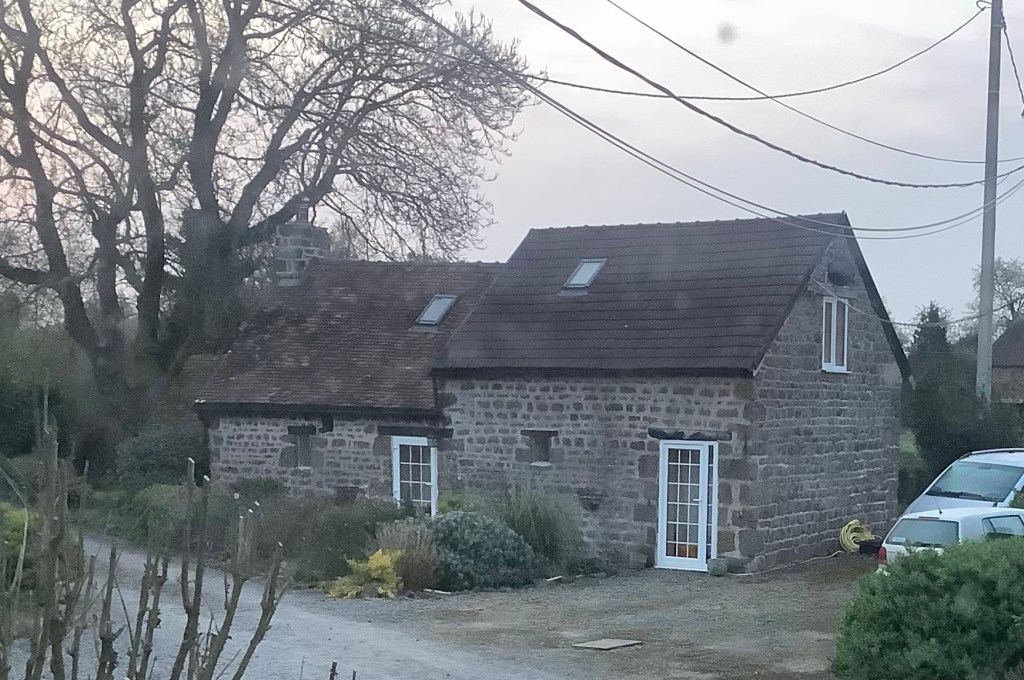
Compare this old cottage in England (left) with the one we see looking out of our window.

The food is one of the few things that remains more French. Cuisine tends to be influenced by the terroir of the land, thus Camembert and cider are icons of this region.

We like Normandie but are enthusiastic about exploring other regions of France, so we travel. Curiosity fuels the urge to wander; thankfully we share that urge.

I Needed a Burger, in France

Thirty six years ago this month I went on a date with the lady who would become my love, the mother of our wonderful daughter, my best friend, as well as my travel and food buddy. We have made it through the ups and downs of any relationship yet we still love to eat and travel together. Today I had my first real hamburger in over 16 months – before we moved to France.

When we moved to France we did so with the intention of embracing the culture, and we have done so quite well. Our UK friends still have people bring them beans and brown sauce from the UK, we have only asked for red pepper flakes and Panko. We strive to eat what is here, though we do make nachos at home now and then. But we live in another country, one that is known for its food, which we accept and enjoy.

One of the challenges of living as rural as we do is that the variety of famous French foods is limited. At even the smallest of cafes the food is done quite well but often without variety. It is the same if you live in rural USA, all the restaurants have similar food, I know as I have traveled there. So we do at times crave different tastes. We go to Mayenne to have Indian food, we get to Paris as often as practical to visit wonderful cafes. But every now and then a food from the past gets into my brain as a craving – a hamburger.

Early in our relationship Tricia, who has a degree in nutrition and food science, told me, “If you are going to have a burger then have the juiciest greasiest one you want, enjoy it, but just don’t do it everyday.” Some folks, when they learn that she has a degree in nutrition, give me their sympathy, thinking we must have an austere diet, au contraire, we eat most everything, but with a bit of balance – frites don’t count of course. So it made sense that when I began to vocalize my craving for a burger she was completely supportive.

The French do eat hamburgers, it is common to see them on menus, even at rather upscale restaurants. McDonalds are relatively common, and it is not because McD has forced themselves on the French. McDonalds is a big business, they would not stay in France if the French were not patronizing their restaurants, the French eat hamburgers.

BUT… Often the burgers I see on the plates of other diners do not look much like what the burgers in the US look like. I did order a burger last summer, the bun was black, not gray, not burned from grilling, but black. I have no idea what kind of flour or process made it that way, I have seen the same at other restaurants. It’s texture was like a macaroon, almost like eating air; defiantly not a genuine burger in my book.

The other interesting difference is that when you see a person eat a burger in France it is almost always with a knife and fork, not picking it up and eating it with your hands. In France most everything is eaten with a knife and fork, even pizza.

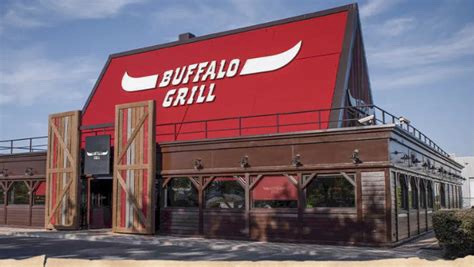
There is a chain of restaurants here in western France that promotes itself as American food, Buffalo Grill. We have driven by them over the year but never stopped, well today we did, in Le Mans.

They have burgers, ribs, chili, even buffalo. So the time and place was right to fill my craving.

I ordered the Extra Cheeseburger – here is the menu description: Steak haché de bœuf façon bouchère ou galette végétale façon chili, cheddar, sauce cheddar, sauce premium, oignon, salade, cornichon. Or, thanks to Google Translate: ground beef steak or vegetable patty chili style, cheddar, cheddar sauce, premium sauce, onion, salad, pickle.

Confusing description aside, it was a genuine American style cheeseburger and I enjoyed every bite – and of course I picked up and ate it properly, with my hands. Tricia had fish and chips, again quite good. So my hamburger craving is satiated for now, and we discovered a place that will work well if we want a taste of non-French cuisine.

I started this blog yesterday, today we are in Montmorillon in the Nouvelle-Aquitaine region of France. We had lunch with friends at a crêperie where I had a galette with chicken and curry sauce, so delicious. French food is great, but every now and then a bit of home comfort is required. We will visit Buffalo Grill again, there is one just 30 minutes away in Flers.

Waiting in France

“Waiting time is not wasting time. Waiting patiently in expectation is the foundation of the spiritual life.” Henri J.M. Nouwen

If Nouwen is correct then France is a good place to develop your spiritual life for this culture has waiting woven into its very fiber. At times I welcome the lessons waiting teaches, other times lack of patience and uncertainty rear their unspiritual heads.

The ubiquitous drive-up service in the US is pretty much non-existant here in France. Starbucks has drive-through and of course you can order on your phone so as to not be inconvenienced by waiting in a line to place your order then waiting again while your order is prepared – no chance of prompting Nouwen’s spiritual life here.

In France you sit in a delightful café and wait patiently for the server, which will most always take much longer than any place you go in the US. Yet you don’t see people looking around trying to catch the eye of the server or overtly flagging them down as would be common back in Seattle. Or compare Japan where many restaurants have a button on the table for the sole purpose of summoning someone, nothing like that here.

Knowing how important un café is, it is usually brought out relatively quickly. However if you are sitting down to lunch minutes will go by between being seated and someone coming to take your aperitif order, and more minutes until it comes – so it goes all through the meal. Wait times between courses would earn even the best establishment poor reviews outside of France.

Yet the French take it in stride, just as they do waiting in a line at the supermarche. Just this morning we waited for a few minutes while the couple in front of us carefully bagged and stacked their groceries into their cart, then engaged with the also patient checker to pay, which was slow as the shopper methodically entered numbers into a keypad. There were at least three more folks with carts behind us, no one was impatiently glaring, they, like us, chatted, knowing their turn was coming.

One does learn to flow with the waiting pace as it applies to shop hours. Yes, many shops close at about noon only to re-open at 2.00pm. Many are closed on both Sunday and Monday. And it is not uncommon to find a place you were intent on going to, which you expected to be open, be closed with little explanation. The only explanation of course is C’est la France!

The most challenging waiting comes from anything associated with the government. France is famous for their bureaucracy and its associated paperwork, something that even my best pre-moving mind preparation did not grasp. No matter what it is you want to do there is a dossier involved and it is impossible to get all of the documents correct the first time.

In June of 2022 we submitted a 1.5cm thick packet of documents to get our Carte Vitale, healthcare card. So far it has been returned, yes the whole packet, four or five times requesting additional information. We last returned it with a letter two months ago, our relocation consultant says that since we have heard nothing from them that is good news, yet we check the mail daily.

Car insurance requires more than just a call with the VIN number and your drivers licence number as it does in the US. All of that for sure, but copies of your visa and all the accompanying docs get sent in. I am enrolled in a French Driving school to get my French licence, the paperwork for that was about the same as getting our visa. You submit it all and days or weeks go by until you hear.

We renewed our visas, starting in January, and of course received multiple requests for more info. We are all set, we have our provisional visa renewal yet are still waiting for the final card, or actually the notification that we can make an appointment with the prefecture to go an pick up our card.

The aspect of waiting that Nouwen does not mention is the uncertainty that waiting can produce. Since he is a man of God he would probably advise that uncertainty is an opportunity to express faith, and I am sure he is correct. BUT when you are waiting for a visa to see if you can stay in the country, car insurance to allow you to drive, etc. it can be a bit stressful as well.

Yet we are getting pretty good at it, or at least used to it. As I finish this blog I realize I get to face the uncertainty of what will happen when I attempt to uploaded it since we have painfully slow internet service out in rural France. So I will hit publish, refill my d’eau minérale gazeuse and hope you get to read it. In the end my goal is to be more like Neville, he has this down perfectly.

A Bistro, an Auberge, or Both – You Choose

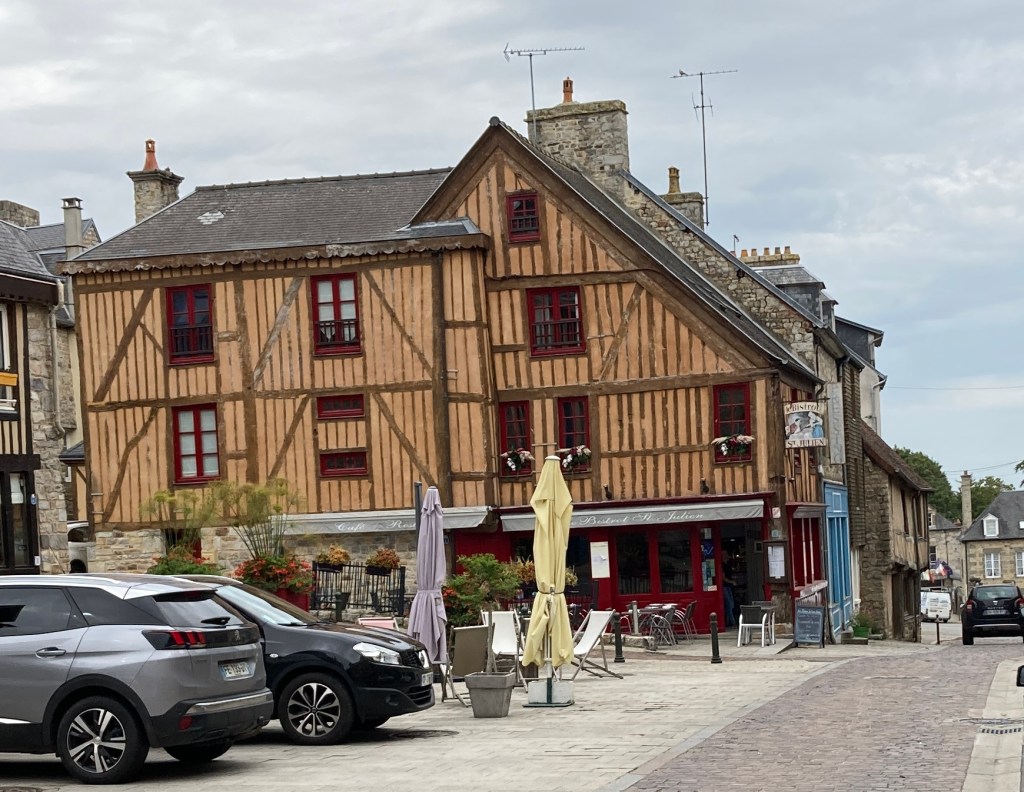
Should you ever get near enough to meet-up with us in our rural part of Normandie for lunch we would recommend a choice between two places: Le Bistrot Saint Julien or Auberge de la Source. Both are about 15 minutes away.

The first restaurant we went to after moving into La Thebauderie was Le Bistrot Saint Julien. In another blog soon I will address the different terms for eating establishments here in France: Bistro, brasserie, auberge, café, bar, restaurant. We chose Saint Julien for the same reason we would take a visitor there, it is next door to the ruins of Château de Domfront, a place we were anxious to see. We have also discovered that in the Michelin Travel Guide for Normandie it is one of only two restaurants listed for Domfront.

A bistrot (bistro in English) is usually a smaller more casual place with a local feel about it. Most will have a menu du jour, which is always the best value. Bistrots usually follow the traditional opening hours of 12h00 to 14h00, though keep in mind that does not mean they accept seating until 14h00, we have been to many places that stopped seating at 12h30 – 13h00. Many reopen later for dinner, Saint Juliens re-opens at 19h00.

This is where we go most often for lunch, we rarely, well I guess never, go out for dinner in Normandie. You know when you have become a regular when instead of au revoir (good bye) when you leave, the owner says à bientôt (see you soon). We have been on à bientôt terms for some time now.

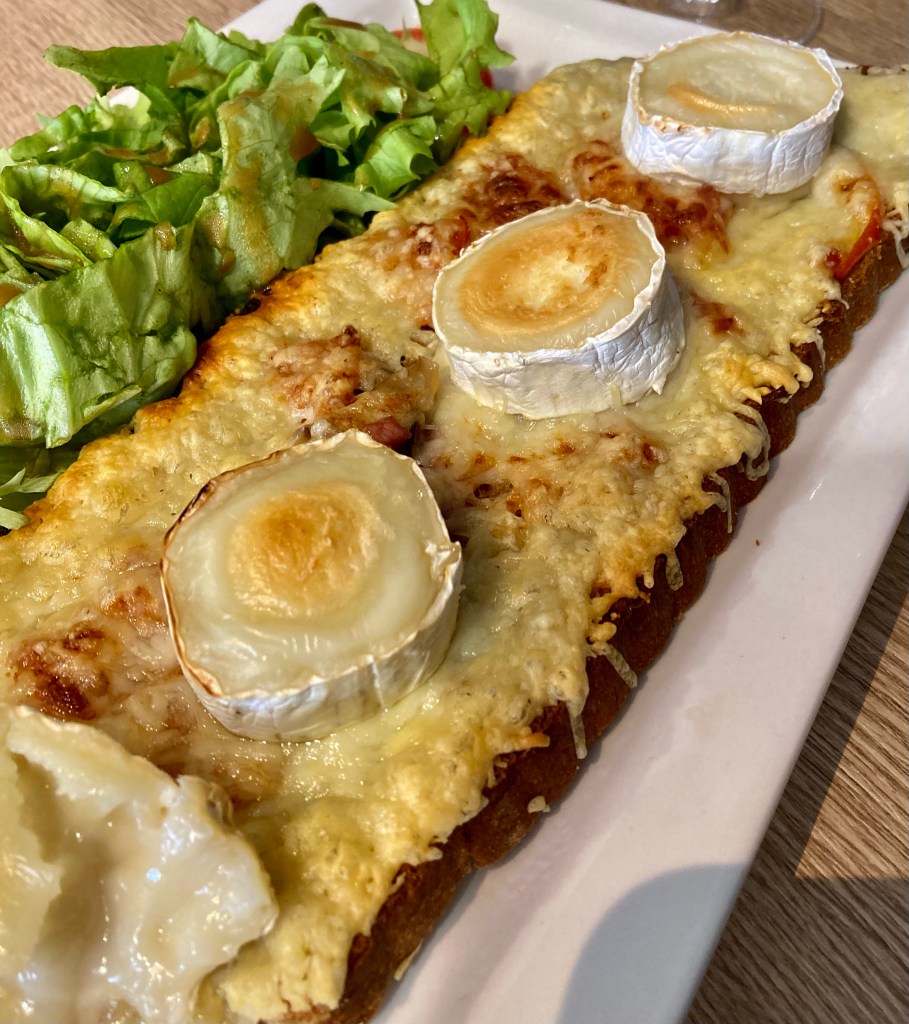
In addition to a changing menu du jour, which at any restaurant in France will have fish on Fridays, Julien’s has a menu of local specialities. One of our favorites are the many tartins. Here is one Tricia had, as always thanks for the photo.

Look at that wonderful chèvre! One of my favorite tartins is chorizo. When our friend Tim visited he was daring enough to try the andouillette, an acquired regional taste; as I remember he quite enjoyed it.

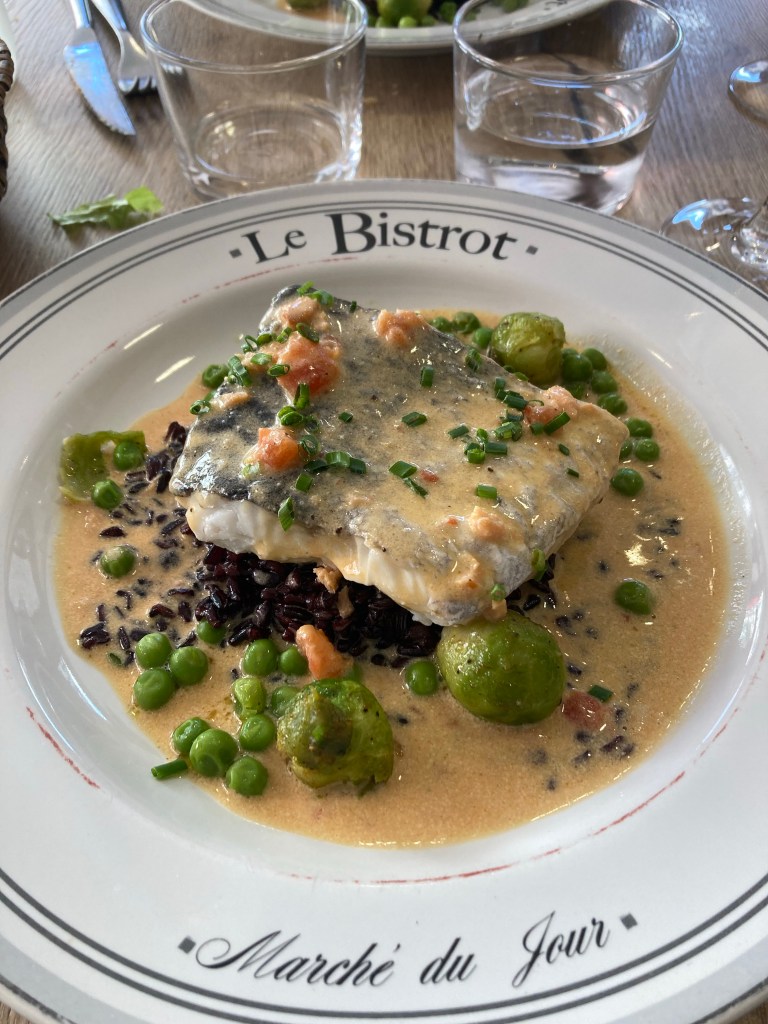
Here is another dish that Tricia had, cod on black rice, and one of my plates.

Auberge de la Source is located in the tiny village of Saint-Cyr-du-Bailleul.

Auberge translates into English as “inn” or “hostel.” Some do have rooms as well as a restaurant. Most tend to be a bit upscale from a bistro but not always – traditional and local products are the norm.

During the week Auberge de la Source only has a menu du jour, while on Friday and Saturday they have quite an extensive menu and no menu du jour, though they do have prix fix options. Like Saint Juliens it is operated by a husband and wife team, something that is quite common here in rural France. The chef at la Source is classically trained and it is evident as soon as you see the first dish, even if it is the apero.

We have had many great meals there, and will have more. Here are a few more photos, thanks again to Tricia for almost all of these in the blog, check other photos out on her blog.

There are plenty of places we go to eat, but these tend to be our most frequent stops. It is a pleasant characteristic of rural France that in some of the most out-of-the-way villages you discover a bistro or auberge, that may be quite plain in its exterior appearance, yet the food and experience is truly memorable. For Tricia and me that is one of the joys of travel, whether it is around where we live or in another country, we do love food – and of course we love it when friends join us.

Best Memories Our First Year in France I

Just a year ago today we were in Cynthia’s (Tricia’s sister) basement putting the finishing touches on packing for our move to France, our friend Dave was set to pick us up on the 14th to take the three of us, Tricia, Neville, and me, to the airport. This was an endeavor that began in earnest at the end of 2021 – already two years behind schedule thanks to COVID.

Moving to a different country is always a challenge so we had a lot to do just to satisfy the French thirst for documents. Dave, who has himself worked and lived abroad in the Middle East and South Africa reminded me that the large companies he worked for took care of most of the details. We hired a consultant for advice but the dossier gathering was on us. And of course after arriving we have had plenty of situations to try our patience, but as they say here, C’est France!

Now lest anyone think that the French bureaucracy or the French culture (i.e. frequent strikes that cancel trains, etc.) has dampened our affection for this country I felt I needed to relate some of the highlights of living here. My plan was to do a blog titled “The Five Best Memories From Our First Year.” But… I came up with a list that I could not pare down to five so will just pass on some good memories now and then.

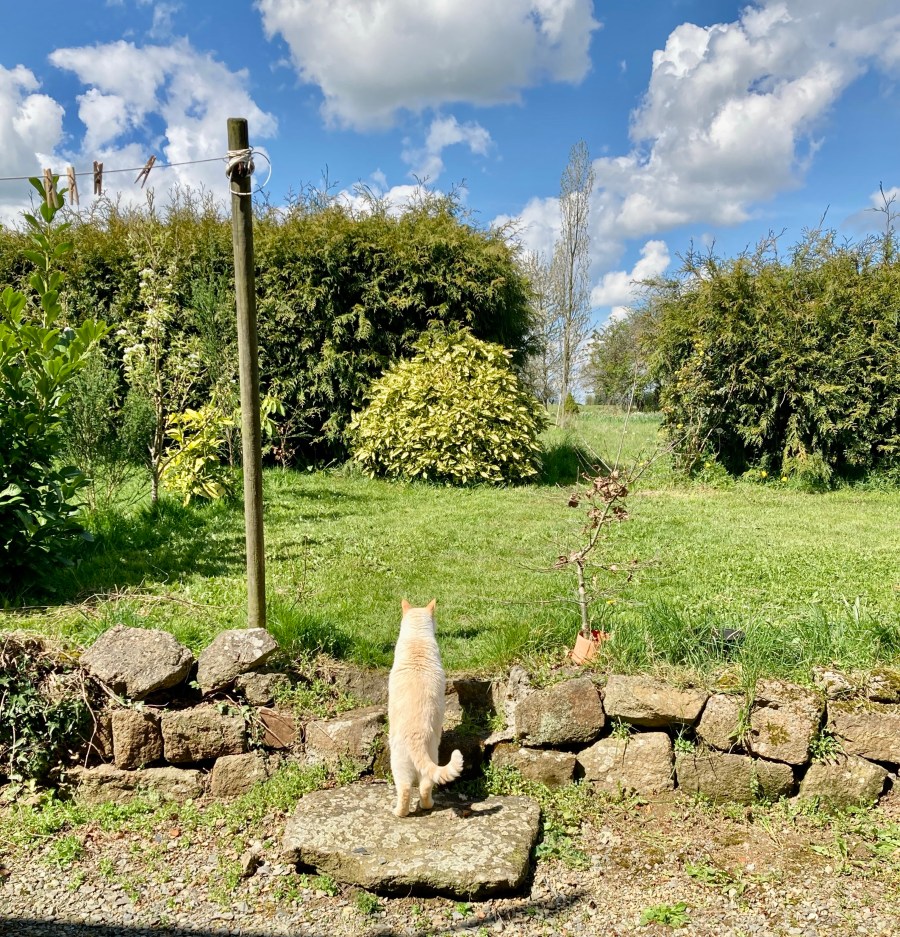
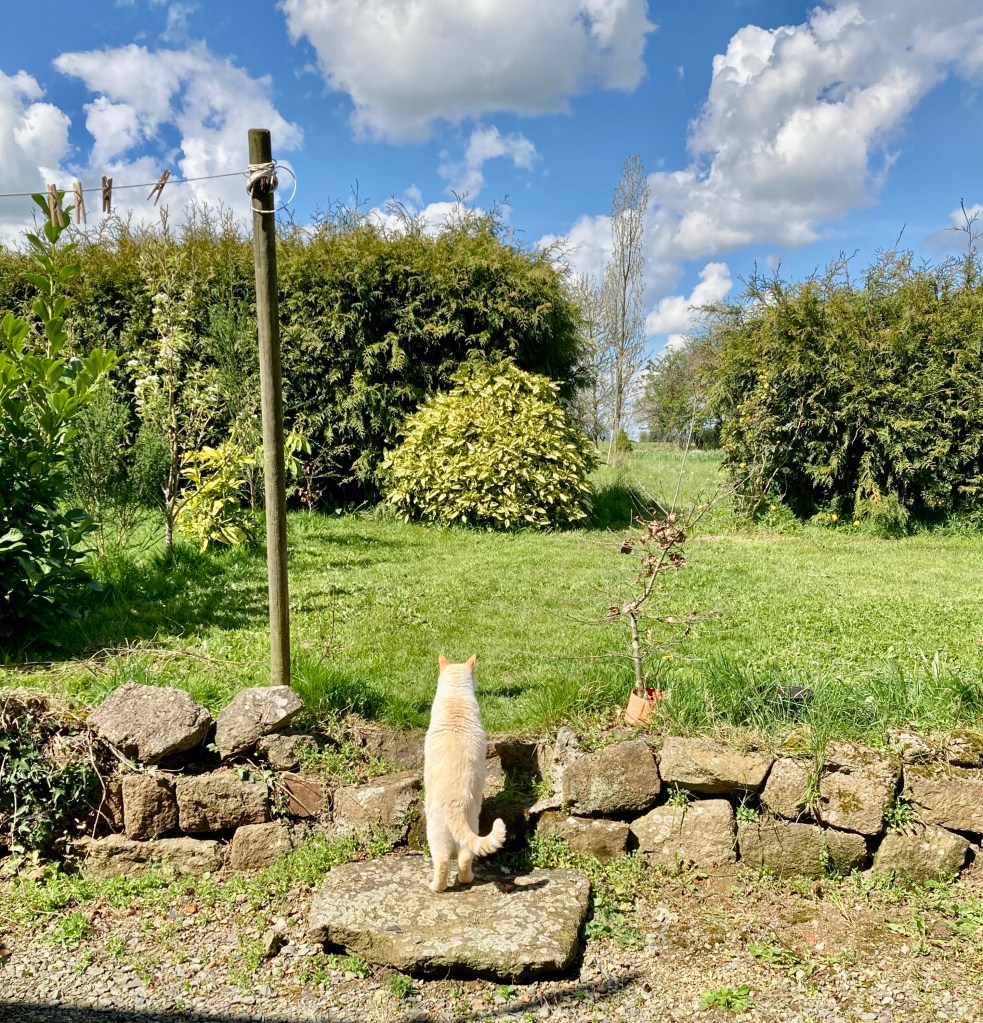
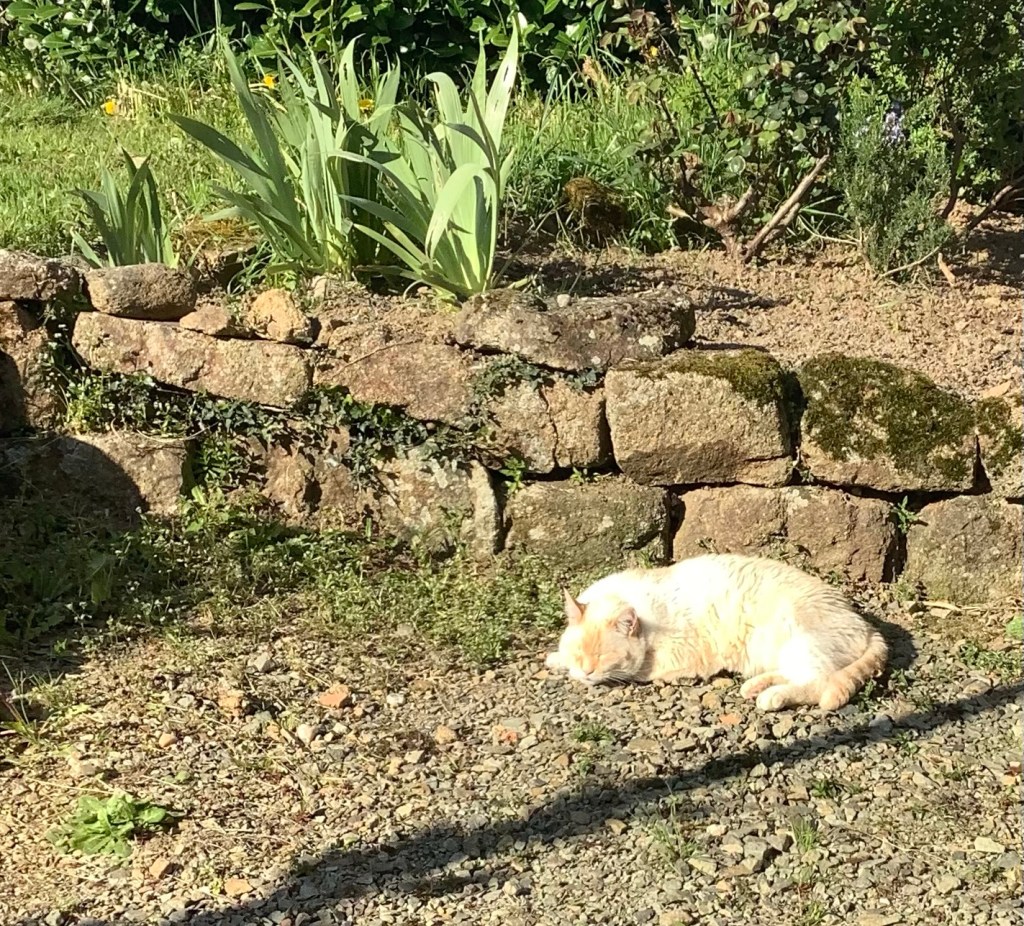
This is a photo of one of my favorite moments since arriving here, it was on 14 April, 2022 – the first time Neville went outside since we kept him inside for the first month. Tricia’s comment was that he must be thinking, “Is this heaven?” There is quite a backstory to this moment.

Photo by Tricia – Travels Through My Lens

Neville was an outdoor cat before we moved into our Martha’s Vineyard condo in Mukilteo where he became an indoor cat with only his catio for going outside, and it was quite small. So if cats have emotions I would think all this space to roam felt great, like “heaven.”

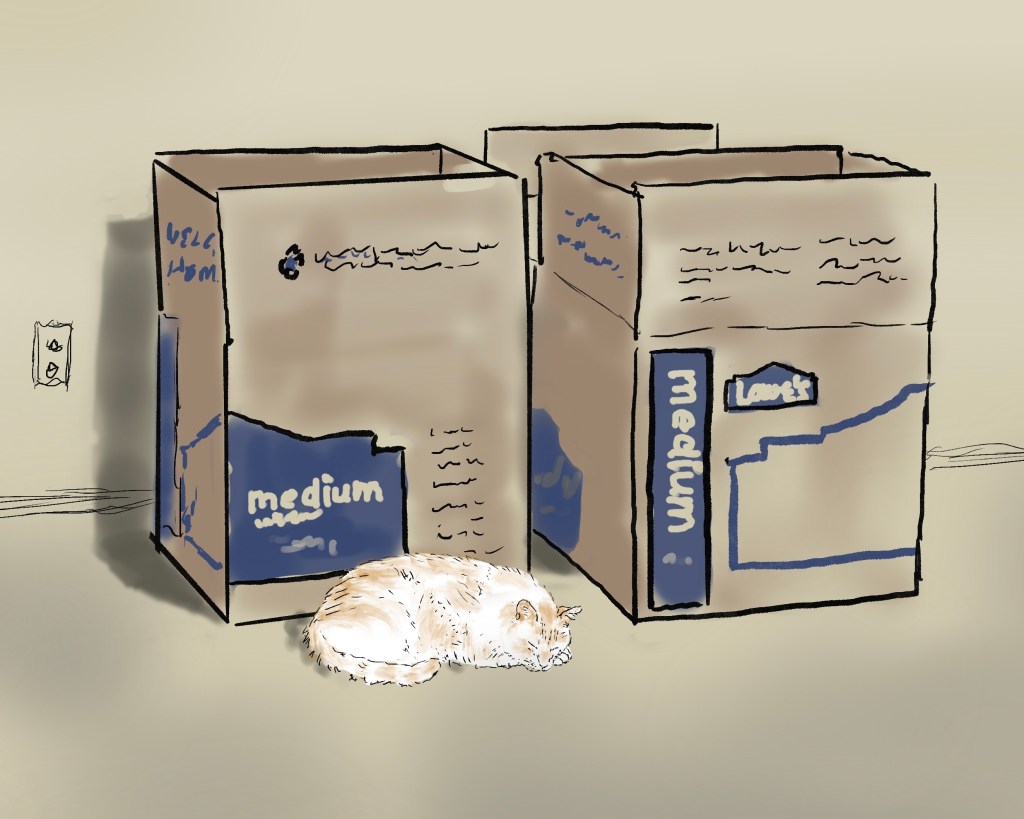
Just getting Neville to France was quite an effort. The EU is quite demanding on their pet requirements, and of course France adds more just because C’est France. Between vet visits, Fedex payments to the USDA in Olympia, and some stressful moments because of narrow time requirements, we had a complete dossier on Neville and had spent over $800, not counting the extra that Delta would be charging us to take him in the cabin with us. We were doing all this while we were packing to move and shipping household items to France, I am sure Neville had no idea what these boxes represented in his life.

Adding to our stress was the vet’s diagnosis in January that Neville had a serious kidney failure in progress, he talked about needing regular IV’s of fluids etc., just to survive, quite serious. I doubted that he would actually live to make the trip to France. Well make it to Normandie he did, after 21 hours in a carrier – checking in at the airport, waiting for the flight, ten hours under the seat at my feet, then a four hour car ride to where we live in Normandie. Neville did quite well. Oh! And never an IV.

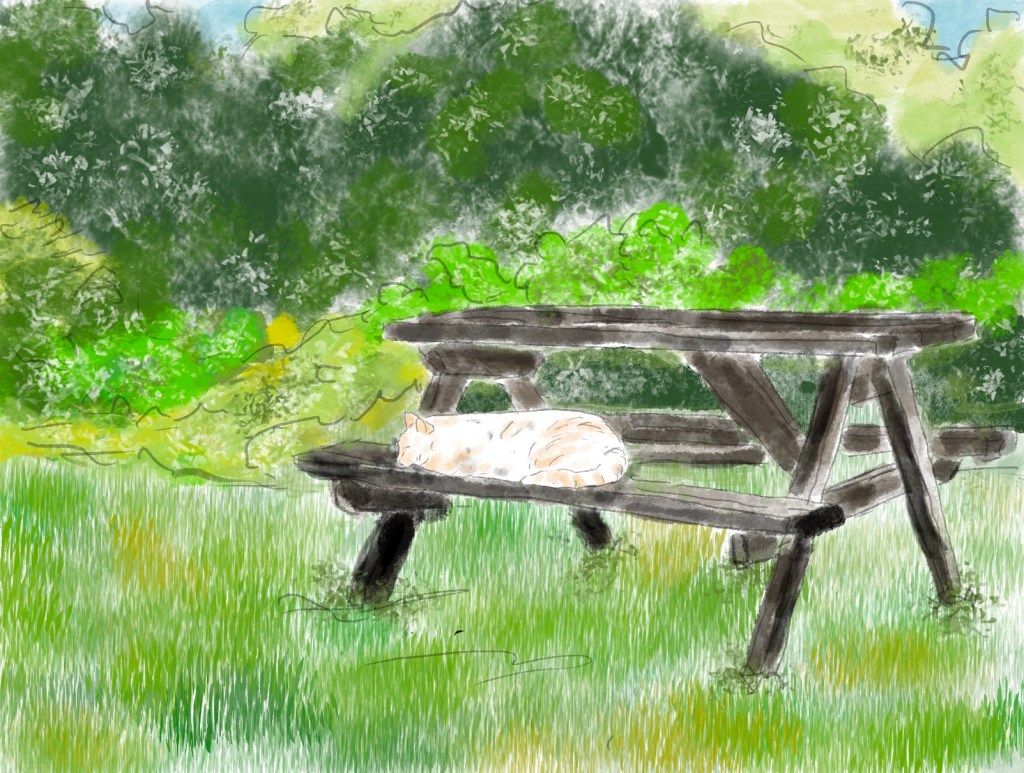
It was spring and warm, Neville loved his rural yard. The old picnic table is good for sharpening claws, sleeping in the sun, and helping me sketch.

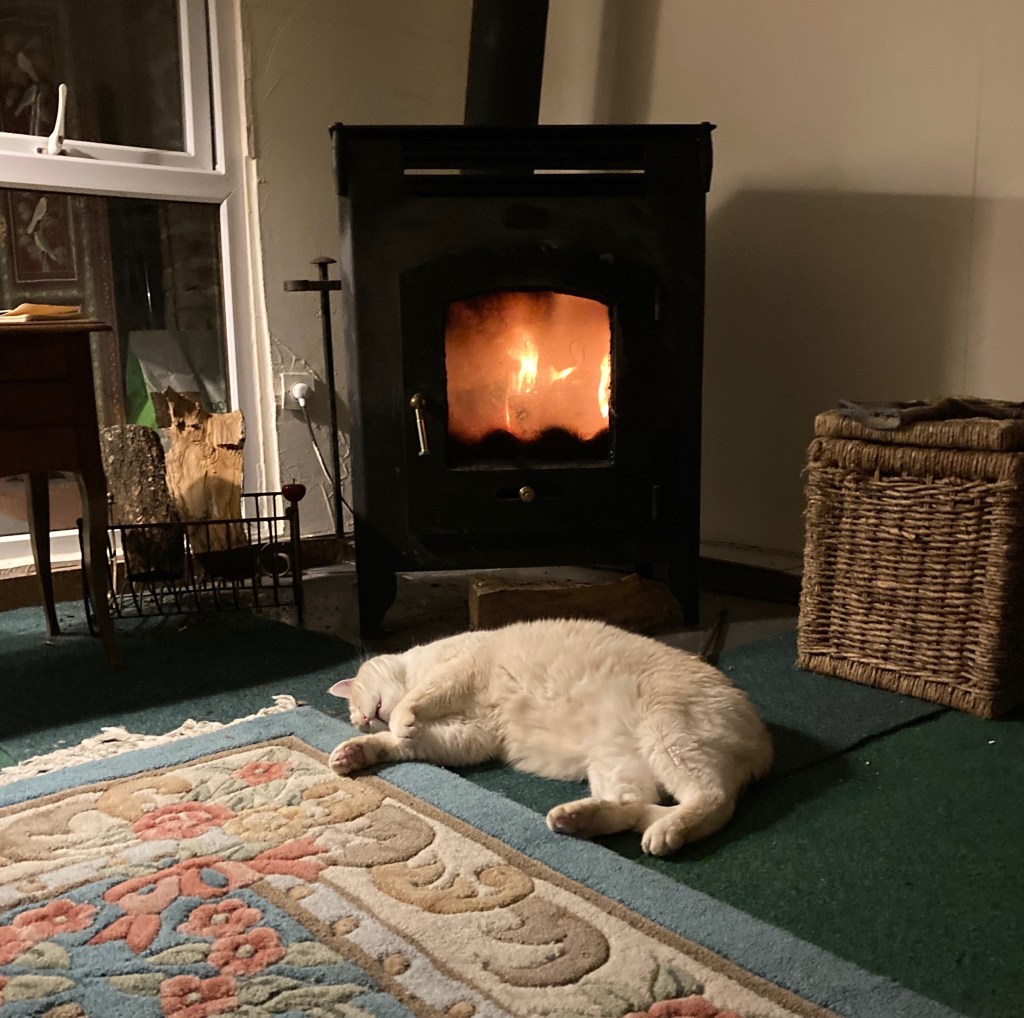
We did have some cool days that made a fire necessary, our main source of heat. Neville exchanged the gas fireplace at the condo for a place in front of the wood stove.

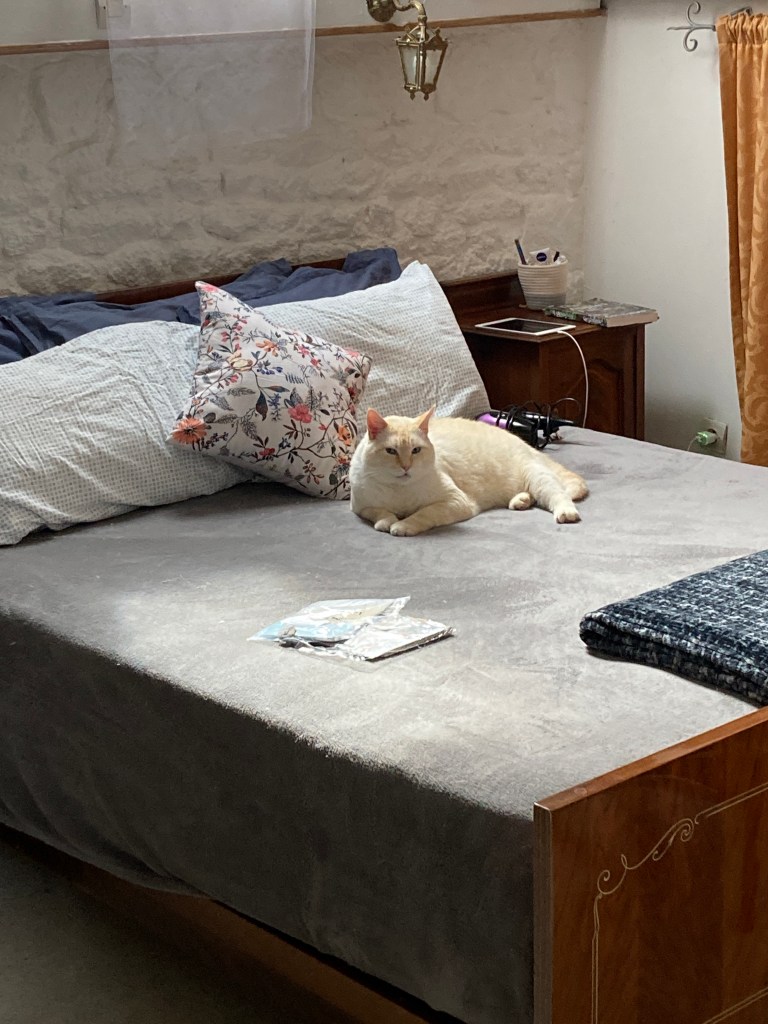
It did not take him long to make our 230 year old cottage his own, settling into his bedroom, where he allows us to join him at night.

So here we are one year later and Neville is as healthy as can be expected for a 13+ year old. He doesn’t go out as often nor for as long, so he is slowing down a bit, but that is what all us senior folks do.

Thankfully he has not lost his touch when it comes to hunting, he is our mighty hunter. I am pretty sure of the count, though Tricia might come with a different number, but I think this is close: 1 in the house while we were gone, the neighbor found it when she came to feed him. 1 or 2 outside, 3 more inside. He always brings them to us for approval, looking quite proud don’t you think? We do live in a rural farm setting so there are mice, but with Neville on the job we sleep well – except of course when he catches one in the night and brings it upstairs while we are sleeping.

Neville has his own Instagram @Nevilleofnormandie and he would love it if you followed him there. He is often featured on Tricia’s blog, Travels Through My Lens and her photos are far better than mine.

One of my fondest memories is that Neville is getting to spend his senior years in this wonderful place that he loves. As I write this he is sleeping in the sun in a basket we found at one of the many brocantes in the area. It warms my heart.

An Expat’s Struggles With Ordering Food

The stereotype for many in the USA is that the French are not friendly, well after multiple trips to France, and living in France for a year I can say that is just not true. In general the French are so kind and helpful. When we butcher their beloved language they may correct a bit but most often they encourage our efforts. Sometimes they are too helpful, particularly when it comes to food.

Now before I continue a DISCLAIMER is in order. I enjoy my British friends and their quirky language, we all get to laugh over terms and pronunciations. However my eating preferences are not British and therein is the problem. In an attempt to cater to our tastes, as they (the French) perceive them, they often make adjustments to my order that don’t work for me.

In my last blog I alluded to one of those adjustments, ordering le café. In one hotel they actually brought me a mug of coffee from a 12 cup coffee maker common to most homes in the USA. Other times I say, “Je voudrais un café, SVP,” the server pauses for a minute then asks if I mean an espresso, a question they would never ask a French person. It comes from their experience of bringing an English speaking person a French le café and having the customer unhappy because they wanted a mug of drip or at least an americano – like I said the French are so helpful most of the time.

Second DISCLAIMER. When it comes to anything bureaucratic that help may be hard to come by – this post is all about food.

The French are carnivores, big time. Vegetarians often struggle, though we are seeing some changes making it easier. Meat preferences in France are often quite foreign to US or UK diners.

When it comes to le boeuf they like it rare, really rare. The go-to degree of doneness is bleu, which, just as it sounds, means blue. The piece of meat is seared for no more than 30 seconds on a side and served. For most UK and USA folks they see this and say it is raw, which of course it pretty much is. Here is a photo of one such steak I had when we were with our friends in L’Isle-sur-la- Sorgue.

The next degree of doneness is sanglant which literally means bloody, this would be extra rare in most restaurants in the USA, it is my normal way to order here. Yet what often happens is the server questions me, “medium?” Or the cook just cooks it so there is barely any pink at all. You see the Brits tend to like meat well done, which is considered unthinkable to the French, and to me as well, so like with the coffee they often adjust.

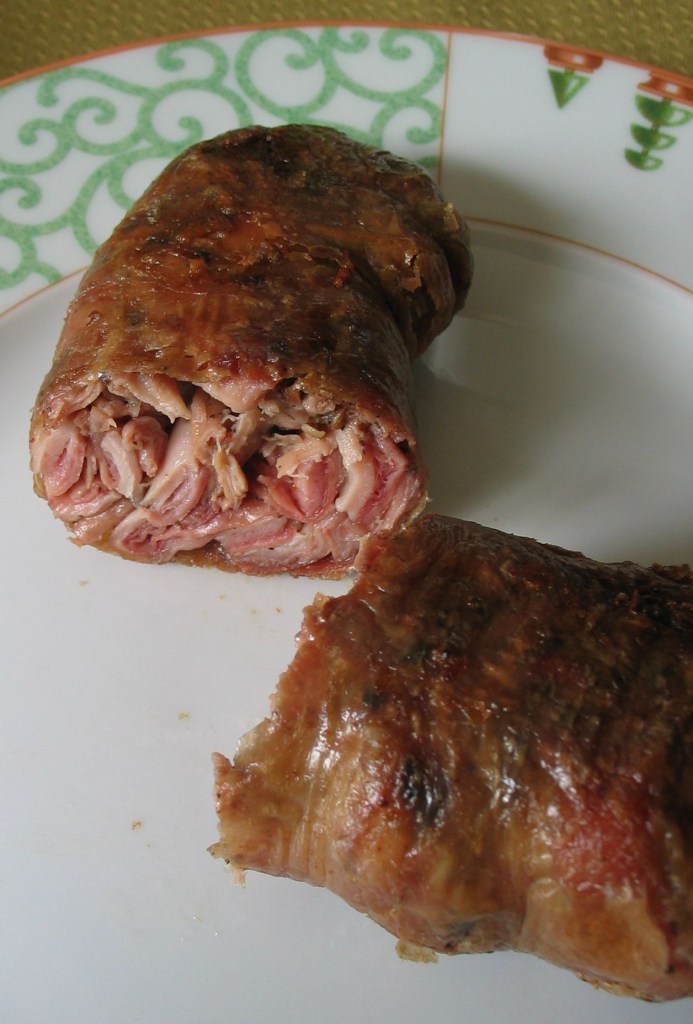
Here in Normandie andouillette, not to be confused with the spicy, smoked andouille from Cajun Louisiana, is on most menus. Here are photos of both.

French andouillette are made from pork large intestines, spices, grains, and onions. They are quite corse compared to the Cajun smoked sausage. Wikipedia says, Andouillettes are generally made from the large intestine and are 7–10 cm (2 3/4 – 4in) in diameter. True andouillettes are rarely seen outside France and have a strong, distinctive odour coming from the colon. Although sometimes repellent to the uninitiated, the scent is prized by its devotees.

The first time I ever ordered andouillette the owner of the open-fired grill restaurant tried to talk me out of it. He said that Americans don’t eat this. I assured him I did. With mustard sauce it is quite OK on occasion. On other occasions the server has asked if I know what andouillette is, or if I am sure. I know they are trying to be helpful, but I also know this expat is not like all the others.

A third challenge here is finding spicy food. With the exception of mustard, which is always Dijon, the French don’t eat much that is spicy. We wanted some salsa, they have Old El Paso, the same brand as we could get in US, but it only comes in mild and extra mild. I can’t imagine what extra mild would be, tomato sauce???

Soon after we moved here we discovered an Indian restaurant not too far away, craving a bit of spicy food we went. It took us a few visits for me to convince the very nice server, that we have come to know well, that when I asked for spicy I meant spicy. In fact last time he actually brought something out that was too spicy for me, that is rare. Yet he is so used to compensating for the French palette that he just naturally tones things down.

In all my years of travel I have attempted to eat like the locals do. I am not like Tony Bourdain was, nor Andrew Zimmern, there are some limits, but in general I say give it a go. Often I end up liking things that might put some folks off, that is one of the joys of travel, and this expat loves the journey of food.

I guess I do agree with Zimmern when he says, “If it looks good, eat it.”

Un Café – The Price of Admission

In France un Café is more than a beverage, it is the cornerstone of the café culture. In the USA coffee is something you do while you do something else, in France it is much more deliberate, for a traveler it is a perfect entry into the local culture.

I have never seen a drive-through Starbucks in France; the drive through food and beverage concept is as rare here as it is ubiquitous in the USA – as are insulated travel cups. In France you stop what you are doing to have un café. The Dunkin Donut idea of unlimited refills is just as strange, as would be a “grande” or “venti” size. These are uniquely American concepts where quantity often supersedes quality.

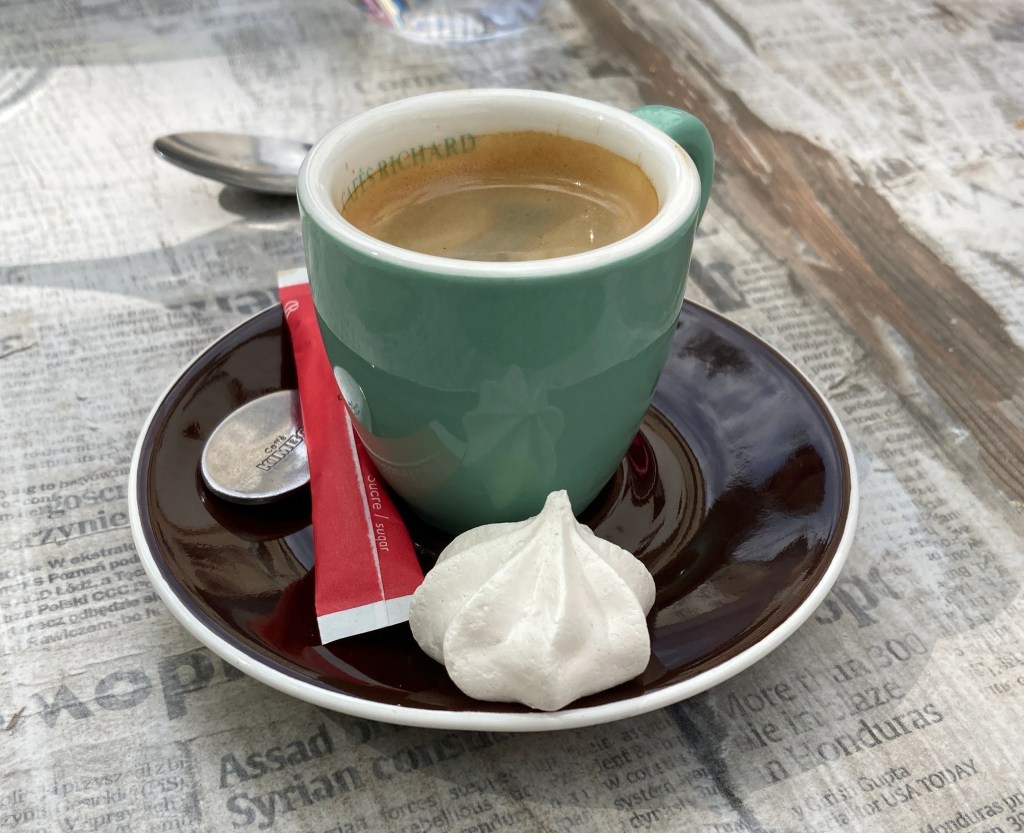
In France this is un café

In its most basic form it is a shot of espresso, always served in a cup and saucer, with a small spoon, sugar – never cream – and a petit biscuit. There are other drinks that are only coffee: un double which is two shots served the same way, un café allongé which is a single with more water forced through, and an americano which is espresso diluted with hot water to cater to the taste of Americans in WWII that found un café to strong – an americano is as close as you will get to a mug of coffee in France. One of my favorites is un café noisette which is an espresso with just a dollop of steamed milk.

One of my frustrations is that often when I order un café, with my best attempt at a French accent, they will either bring me an americano, or clarify that it is espresso I want, as they are so accustomed to folks from UK and USA not wanting a real un café.

In France coffee with milk is rarely consumed after early morning, having a latte in the afternoon clearly signals you are from Starbucks country. Un café is the norm after a meal, but of course without milk.

Un café is also your ticket into the café culture, you can sit for hours at a table, with no one implying that you need to give up your table, participating in the French pastime of people watching, or in my case sketching.

Le café and les cafés are one of the things I like the most about France. Whenever possible I go early and enjoy starting my day watching, sipping, and sketching.

Manifestations and Menu du Jour

Menu Blackboards, about A4 size (8.5×11.5 inches), for setting on a table, or 2×3 feet for leaning up on the floor next to a chair, or as an a-frame next to the entry of the restaurant are the ubiquitous icons of French dining, as is the Menu du Jour which is chalk-written on them each morning. With a reputation for the best food France is obsessed with normalcy.

Photos courtesy of Tricia and Travels Through My Lens

A Menu du Jour has three courses: entree, main, and dessert. There may be a choice in each course of two or three items, but the menu is pretty well fixed. Many restaurants will have other menu offerings, but if you observe the locals they tend to order the Menu du Jour, or the Plat du Jour which is simply one of the mains. Why? Because the French are obsessed with normalcy, deviation can result in manifestations – or protest. The stability must not be threatened.

French food is most always done well regardless of the price. We have had quite good meals at obscure, mundane establishments. However there is always predictability. Fridays will have fish, though the country is officially secular according to the constitution, the centuries of Catholicism still are considered normal, even for the majority who never enter a church. The menu will have mostly meat mains, except for Friday, as the French are carnivores, some think fish counts as a vegetarian meal. For dessert you can almost bet there will be chocolate mousse, even if other more creative offerings share the blackboard.

There is good, even great, food to be found and it is worth the search. One such place was Chez Dumonet, an old resturant in Paris where we ate in December – yet even they had a prix fix menu – because the three courses are expected – normalcy.

Lunch is sacred, it is a long and slow affair, even in rural areas with a clientele of farm or construction workers; no sandwich in the cab of a pick-up truck here. Normalcy. There is even a law, though relaxed during COVID, forbidding eating lunch at your desk. Lunch is sacred, normalcy, don’t rock the boat.

Yet even a cursory glance at the history of France makes it clear that it has never been a stable country. For much of its history France was really just Paris, the rest of the country was run by dukes and such who ignored the king and spent their time fighting with each other while taxing their subjects. The famous French Revolution was not some break from tyranny resulting in a government by the people; just a short time later Napoleon was a dictatorial emperor. It was not until the 1900’s that the France we see today began to emerge, and even that was disrupted with occupation by neighboring Germany.

Today the French cling to stability, protecting established practices and institutions. When these are threatened by new laws or programs manifestations are soon to follow. Street closures are even posted on days when a protest is expected, and the Parisian response is “C’est France.”

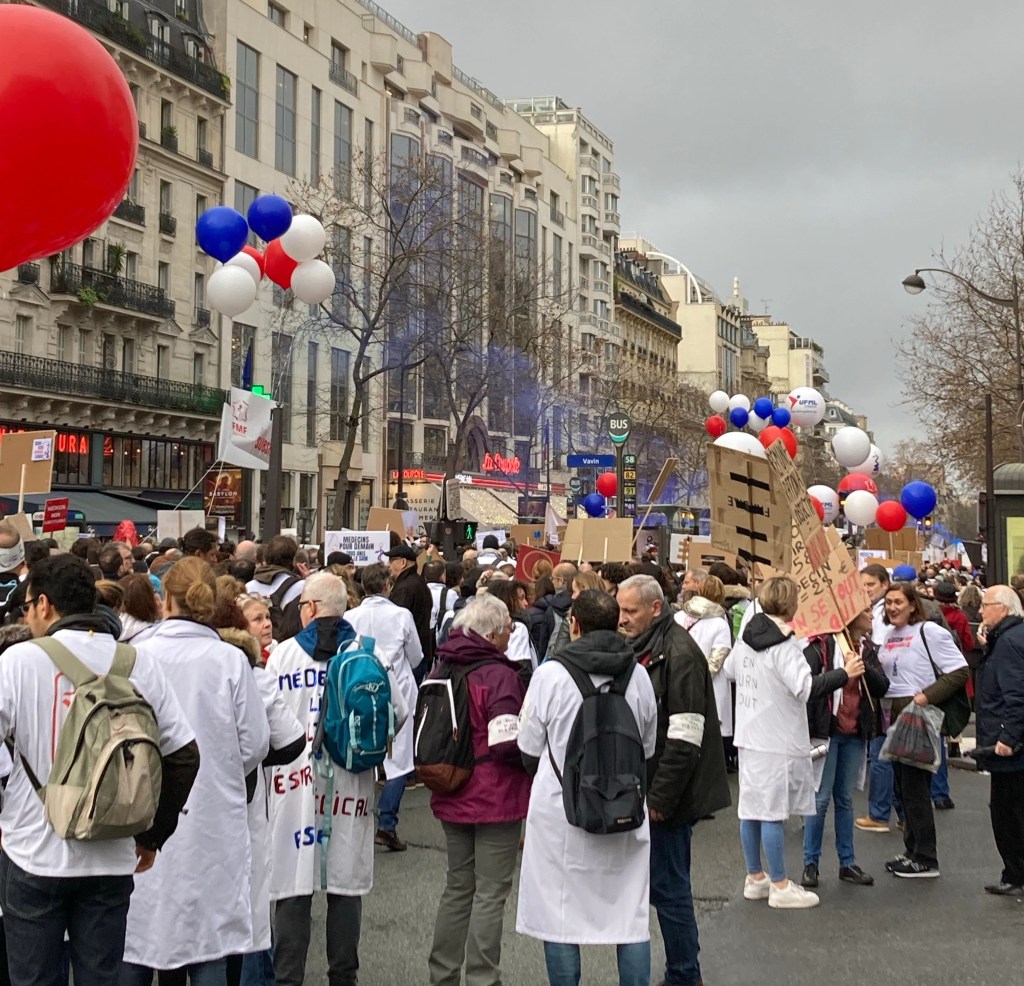
Tricia took this photo of a protest when we were in Paris in January – Healthcare workers.

As I write, protests are happening in major cities, for the second week in a row, with another “General Strike” planned for Saturday, because the government wants to raise the retirement age from 62 to 64. The railways and Metro are shut down, a million people marched along the Champs-Élysées, some turned violent resulting in teargas and broken shop windows. Don’t mess with the normalcy of the earliest retirement of any industrial country.

Yet you can be sure that the restaurants not on the parade route have their blackboards set up, even protesters need a sense of normalcy and where better to find it than over a predictable meal and a glass of wine, ok maybe two glasses, but it is also true that over drinking at lunch is not a French thing. Normalcy.

Though France can be quite tolerant, there is also an undercurrent of selfishness. Shutting down the transportation system does make a statement to the government, but it totally disrupts the lives of millions.

Twice we have had to make major travel changes due to the railway strikes. And with our daughter coming to visit us next week we are concerned about another strike since they are taking the train from Paris Montparnasse, which seems to be protest central, to Flers in Normandy. If the train is shut down we will have no stability and even the best blackboard menu will not make it normal.

3 Reasons Why I Like to Travel

“Why do you like to travel?” Tricia is writing a post for her blog Travels Through My Lens about why people like to travel, and pondering why some don’t have any desire to travel; she wanted a quote from me. It got me thinking. My initial response was:

“What I like about travel is feeling immersed, if only for a moment, in the culture and ambience of a place I’ve never been before.”

That does encapsulate the essence of why I may get tired while traveling, yet never tire of traveling. Her question got me thinking about what attracts me most to other places. It all comes down to three things:

1. Cafes

2. Cathedrals

3. Sketching

Cafes

Mornings are my favorite time of day, the best part of the evening is going to bed so I can get up in the morning. When I travel, alone or with Tricia, most mornings I either quietly have tea in the room while she sleeps, or, more frequently I head out to a cafe. One of the first things I do when we get to a hotel, or a BnB, is to scope out a coffee shop. Before going to bed I lay out my clothes, reading materials, and sketching kit so I can quietly get dressed and leave, hopefully without waking Tricia.

At the cafe I feel like a local, most tourists take vacation as an opportunity to sleep-in, I don’t begrudge them that for a moment, it just keeps my morning less crowded; if I sleep in until 0800, even 0700, I feel like I have missed the best part of the day.

In the cafe there is time to read some news, the Morning Office, a book. I might explore a map planning the day’s adventures, specifically focusing on a good place to eat lunch, which is usually the high point of our day. Cafes, bistros, and restaurants are a priority for us, and an important part of why I travel.

Then, settled in, it is time for a sketch. In Robion, a couple of years ago I went to the same cafe every morning, did four sketches, one each morning. Each was from the same table, just facing a different direction.

Cathedrals

The cathedrals and temples in the world are worth visiting. Of course the magnificent ones – Notre Dame in Paris, the Duomo in Florence, Bath Abbey in England – are awe inspiring, but they are too crowded for my taste. (Visit early or late to avoid crowds – Friday Prayers at Bath Abbey is my recommendation)

Gordes is one of those places in France I love to visit, sadly so does every other tourist who goes Provence, so I am faced with the crowds. Just off the circle at the center of town is Eglise Saint-Firmin, a small and in need of sprucing up cathedral. Never crowded, a bit dark, always quiet. A few minutes sitting spent on the old and warn pews, considering the icons and flickering red candles, triggers all kinds of reflections on what is important in life.

Grand gardens and parks are just variations on cathedrals, as are mountains and vistas. My mind is freed up to be creative, for introspection, peace and meditation. Next to morning cafes and midday restaurants Cathedrals of stone or nature are the best part of travel.

Sketching

Pretty obvious that this is a priority for me. Sketching allows me to connect with the place, it forces me to slow down and really observe – the colors of the building, the shapes, the people and what they wear. In the time I am sketching I am completely immersed in the terroir of where I am. Later, when I flip through a sketchbook, a bit of the feeling comes back, it is like being there all over again. Those sketches of Robion renew those wonderful morning cafes.

Tricia’s Quote Expanded

I think I need to give Tricia a more complete quote:

What I like about travel is immersion, if only for a moment, in the culture and ambience of a place I’ve never been before. I may get tired while traveling, yet never tire of traveling. It all comes down to three things: Cafes, where I connect with the locals, cathedrals, where I am inspired, and sketching, where I capture the moment while creating a memory.

Japan – a prepared adventure

Delta 167, Sunday July 17, 2016 – Non-stop Seattle to Tokyo’s Narita airport. Hotels in Tokyo and Kyoto are booked, house and cat-sitter all arranged, we are set. That is really all we have planned, no detailed itineraries, not much in the way of “must see.”I will readily acknowledge that our approach to travel is not for everyone, yet I encourage folks to give it a try. Three components: Spontaneous plan, Light packing, Technical Logistics.

We arrive on Monday, mid-afternoon. Saori, our Japanese daughter, is going to welcome us at the airport, assist in picking up Wi-Fi hub at airport, then navigating us on the Narita Express to our hotel. Then we will take her to dinner. That is about the extent of our definite plans. The rest is pretty much make it up as we go. There are only two things I specifically want to do, Odawara Castle, and a train that goes near Mt. Fuji. We will work these out when we are there.

Readers of my blog know that “tourists must see” lists don’t do a lot for me. Beyond that we have learned that all of the research in advance helps, yet when you get to the place you are going it looks different, strict agendas made 10,000 miles away are restrictive. Then there is the physical demands, some days we feel like doing nothing. I remember afternoons in Bruges, sitting by the fire at Rembrandt’s, reading and snacking for hours, one of my best memories of Belgium; you don’t really plan for that kind of day, they happen if you let them.

Luberon is a small village in Provence, France. On our first visit to Provence, Tricia was not feeling well one evening, I went down to the bar in the hotel to let her sleep. As normal I struck up a conversation with a local. She told me that Luberon was not to be missed. The next day we headed for Luberon, I had a Croque Monsieur at an outside café, we bought local pottery from the shop with the blue doors in this painting. The joy of spontaneity.

The second important consideration is light packing. We will go to Japan for 17 days, and we will each have a carry-on size roller, plus a small carry on. This is so important. You are flexible if you need to take trains, navigate stairs. And you are not burdened with stuff. I know it is often repeated but it’s true, the longer you travel the lighter you pack. Set out what you think you need to take then cut it down, then do it again. Light packing means flexibility, and that adds to the spontaneity. I must admit that when I see couples travel with two huge cases I really wonder what they are taking and how much they will use. One exception, when we have gone places where hiking is on the agenda we take a larger case, boots and packs do take up space.

The one place I do spend time planning is the technical details. This includes maps, plugs and chargers, Wi-Fi, and a few miscellaneous goodies.

Maps are a big thing for me, first I love them, but I really like to be able to find my way around. With a WiFi hub Google maps navigating works on iPhone or iPad. I also use Maps-2-go, they are offline, and since the GPS works on my phone even if not connected to phone service, it will find you on their maps. Maps-2-go also has great place to store lists of sights, restaurants, etc.. So with these two in place you are ready. Google also allows you to download maps for offline use, along with stored favorites.

If I need directions to a hotel, or for driving, I do turn-by-turn maps of directions before the trip. These are stored in an offline notebook on Evernote, a bit of redundancy I know but it’s comforting when in a strange town and you need to find your hotel. With Google street view you can take pictures of the area around your hotel to help you spot it when on the ground. This helped us in Barcelona and in Provence.

It is obvious, but worth reminding, that you need adapters and chargers for all your electrical stuff. Thankfully unless you have really old electrical items most are already 110/220V so you don’t need a converter. Take more than one adapter, they are small and you probably will want to charge phone and iPad at same time.

I travel for pleasure with only iPad, it does all I need and is lighter than computer. iPad and iPhone pretty much take care of everything from music to navigation. A Bluetooth speaker brings music into room, Google Translate app (different than the online translate) is brilliant as it will capture the text of a sign or menus and translate, no internet needed.

 Couple of things I carry, a real tea cup, and immersion heater- tea in the morning is important so I make it possible most everyplace. Along with that an acrylic wine glass, wine and beer just don’t work out of the placid stuff at hotels.

Travel should be a prepared adventure, take what you need, resources for what you will need, and the curiosity to let each day unfold as it will. Bonnet voyage.